Symposium 2026
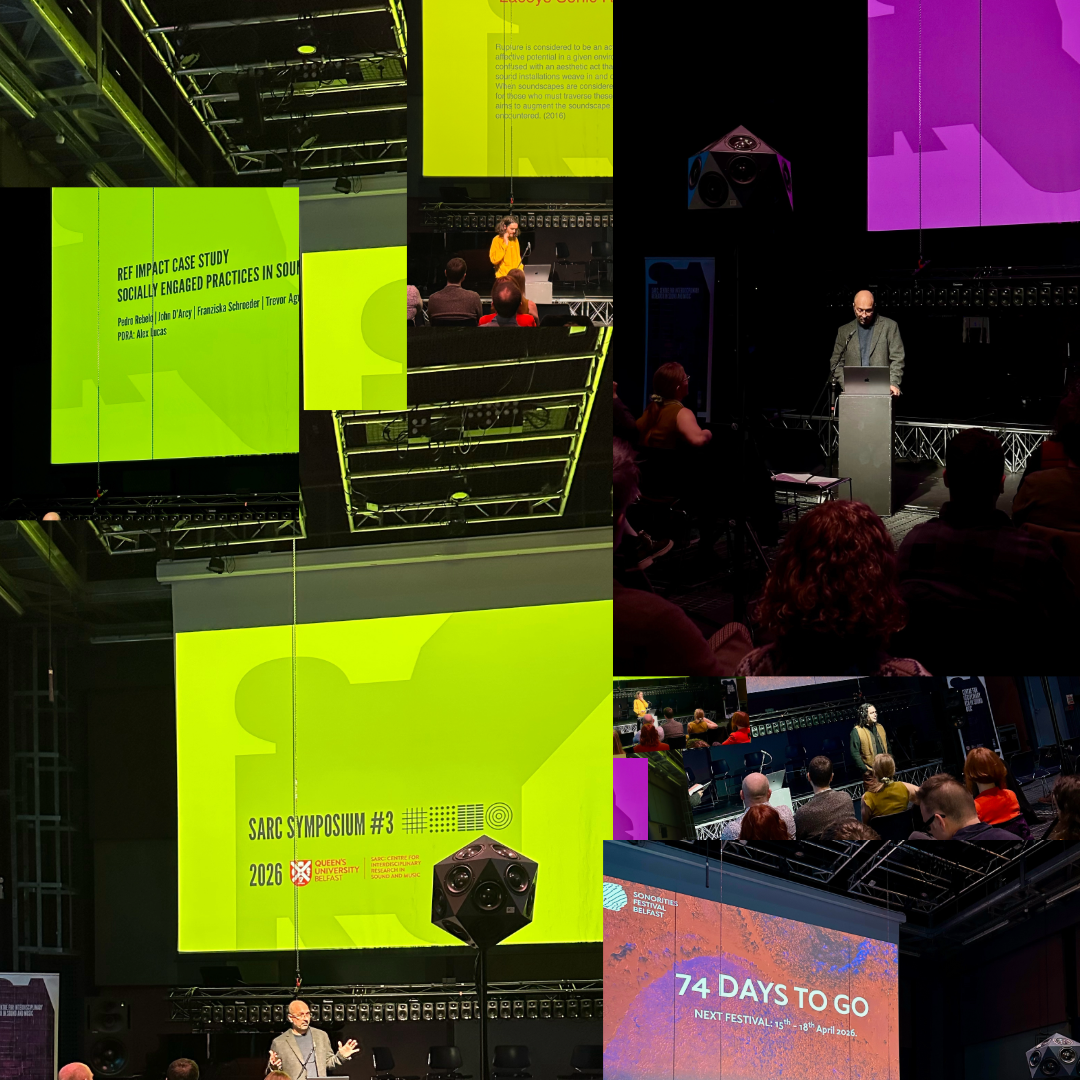
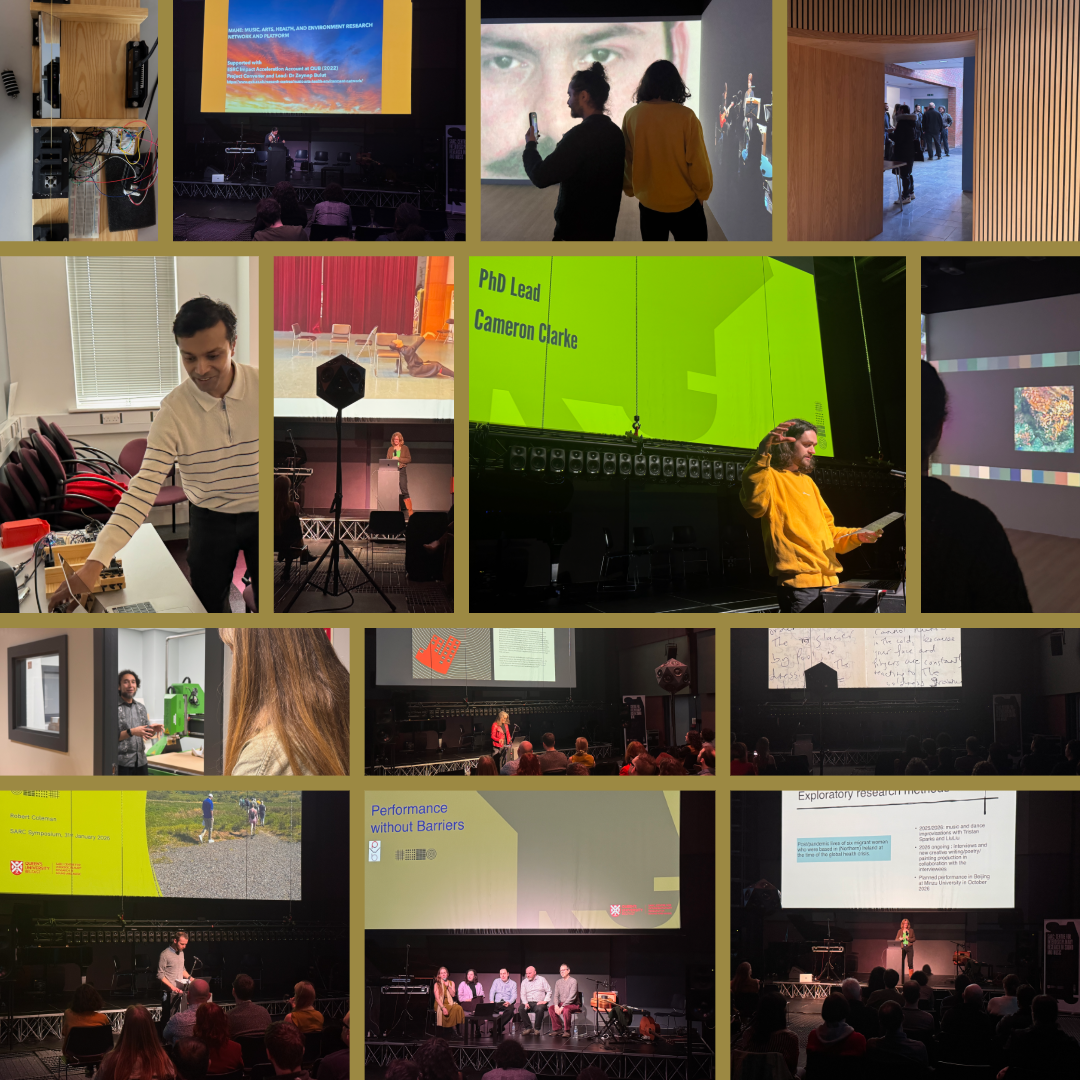
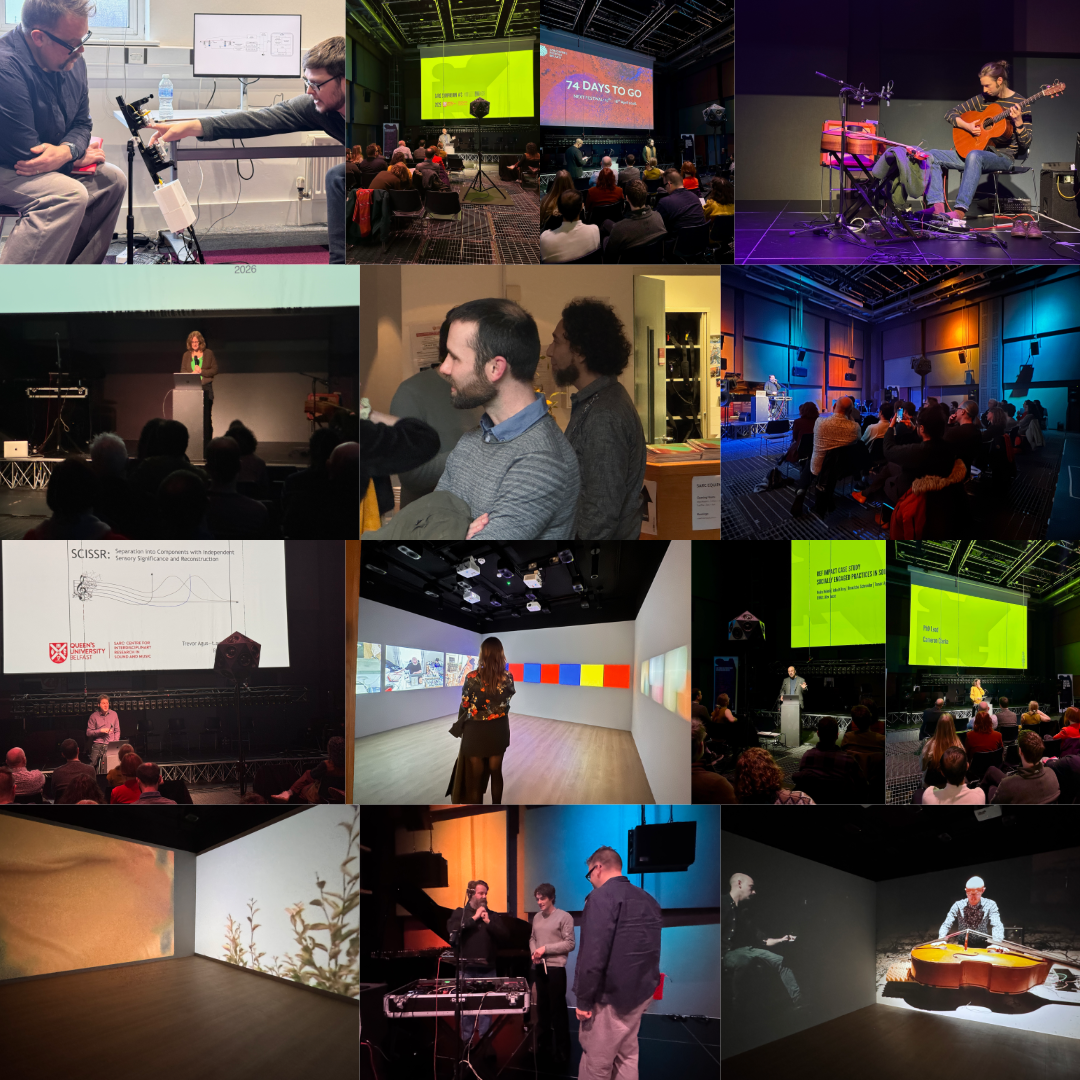
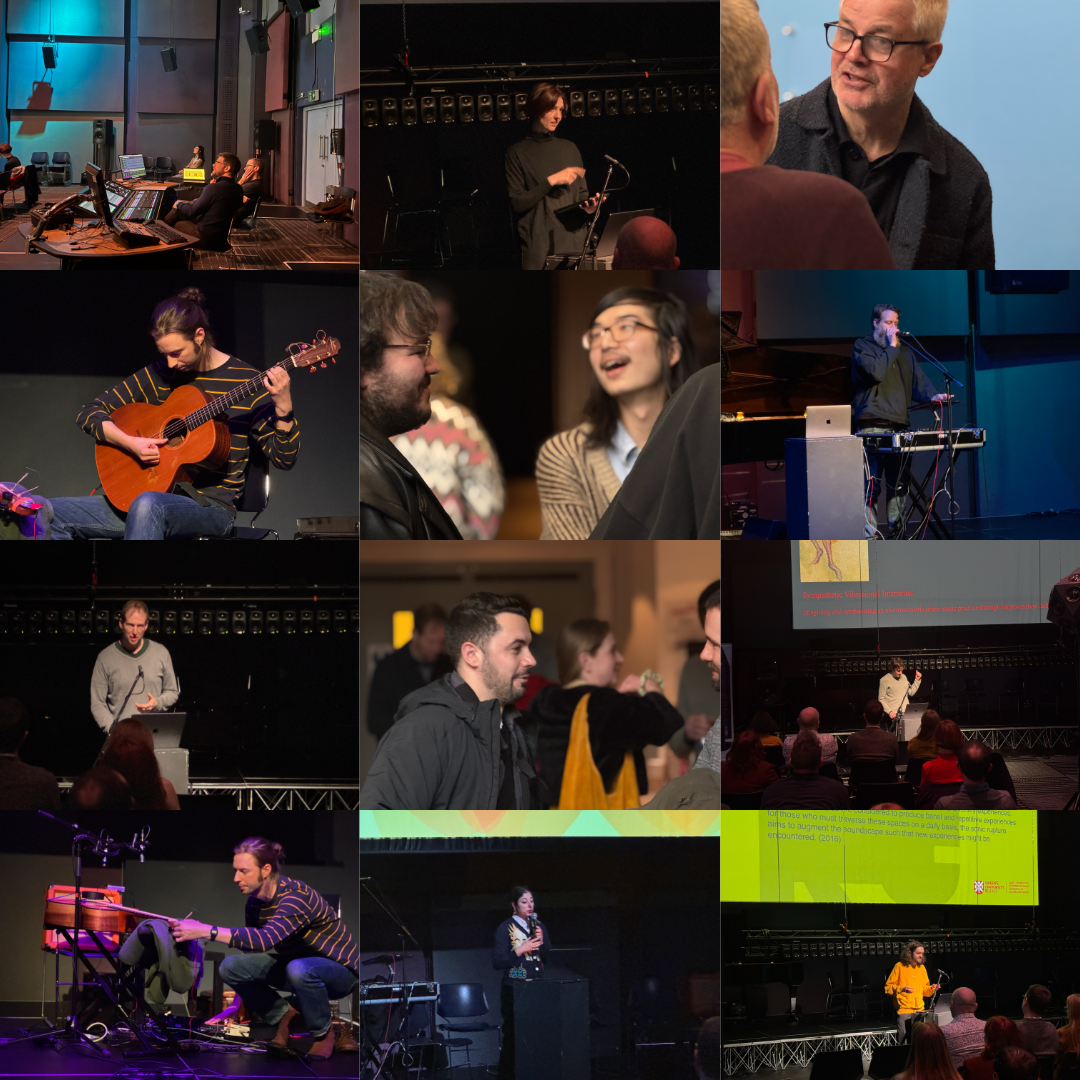
"We’re delighted to announce the third SARC Symposium, taking place on the 31st January 2026.
The programme includes short lightning talks, panels, demos and performances by over fifteen SARC researchers. This is also an opportunity to visit the new SARC building facilities including the Maker Space, PhD Lab, Stage Box performance and teaching space and the opening of the new SARC Gallery.”
Pedro Rebelo
Director
SARC Symposium 2026 Programme
11:00 Opening
Pedro Rebelo SARC Update
Pedro Rebelo and Craig Jackson SARC Building
Cameron Clarke PhD Culture
11:20 Lightning talks
Trevor Agus SCISSR: The development of a tool for fine audio manipulations
To avoid artefacts, sounds are often be faded out or filtered smoothly; it is difficult to manipulate directly the more fine-grained spectrotemporal cues upon which sensation and perception are built. In the cochlea, sounds are effectively filtered into narrow bands, such that most sounds, most of the time, can be represented as a combination of sinusoidal components that each dominate activity in a part of the cochlea for their duration. This Separation into Components with Independent Sensory Significance and Reconstruction (SCISSR) provides a means to view these microauditory fragments and manipulate them, even if reconstructions are as yet only near-perfect.
Sarah Lappin Monograph in process -- House Music: the Soundscape of Domestic Modernism
In 1951, Frank Lloyd Wright stated, “I couldn't tell you anything about acoustic laws”. This uncharacteristically modest self-appraisal came from one of the 20th century’s most emulated architects, one who had an enormous impact on the design of the house. Wright’s domestic work was part of a significant shift -- in the first half of the 20th century, architects radically changed the way houses were made, removing long corridors and fussy decoration in favor of stripped back, open plan rooms. These moves still have momentous impact on our domestic soundscape, but their acoustic implications have never been thoroughly examined in architectural history, until now. House Music unpicks the sonic history of five long-revered houses: Robie House, Villa Müller, Villa Savoye, E1027 and the Eames House, discovering if and how their architects thought about sound, how clients adapted to these new sound worlds, and how we should conserve them in the future.
Andrew Molyneaux Brooks Three Field Lines - Field Recording Graphic Score
"This presentation introduces a notation methodology for the interpretation of field recordings based on an existing artistic practice and prompted by improvised performance. The method develops a framework for listening and interpretation adapted from Chris Watson’s “tripartite approach to the layering of sound” for the creation of natural history soundtracks, as described by David Chapman (2017). Rather than functioning as a recording or compositional strategy this approach is applied as a listening and interpretation practice, gesturally scoring field recordings through the inferred audio strata of environment, habitat and species.
Although provoked by process and performance, the methodology is proposed as a tool for community co-produced sound mapping, offering an accessible structure for critical listening and engagement to collected recordings."
Cameron Clarke In defence of a loud Sound Walk
A talk that looks at my most recent sound walk 'Do Weird Stuff in Town'. A sound walk where participants were given various microphones (electromagnetic, contact, geophone) to interact with the urban landscape. in this instance the sounds were not contained in participants headphones but radioed to a portable sound system and mixed live. The result was a mobile loud and joyful intervention in public space where uncovered sounds were broadcast to the public as we made our way through town finding all sorts of secret sounds.
Eimer Birkbeck Field recording - embodying the edge position
In my research over view presentation I would like to respond to Anna Lowenhaupt Tsings' who borrowed the ecological term 'edge effect' to explore the strange spaces of partial contact between birds and humans in boundary zones between habitats. I would like to discuss the 'edge position' of listening during the act of field recording, wherein I discuss openly the physical material methods of current research projects and how being bodily present in avifauna habitats shapes the nature of the extraction, encountering the field as a mutually unpredictable site of indeterminable and unknown relations. I experience field recording as an open-ended process of attunement which generates site sensitivity, which in turn foregrounds the bodily subjective nature of the inquiry, listening as enabling sensory perception and participation within these spaces of contact. I am also considering the physical nature of studio work, as sounding the bodily experience of listening, as a process of re-entering and re-encountering the multiple sites of contact. How do Field notes enter as an inter textual material, do they distill the beingness of place, passage and presence.
Robert Coleman Overview of my PhD research: Creating Ecological Soundwalks Through an Enmeshed Ecoacoustic Practice
This presentation offers a brief overview of my PhD research, which integrates ecoacoustic approaches with embodied listening and creative practice. Ecoacoustics is an interdisciplinary scientific field that examines the relationship between biodiversity and its environment through sound. Alongside this, embodied listening practices, particularly the study of bird language emerged for me as a way of attending to environmental detail and relationships at a more intimate scale. Together, these methods supported a considered, structured, and long-term engagement with place through sound. They became not only a methodology for researching my study sites, but also a means of developing my own perceptual awareness, fostering a more sensitive, and what I now describe as ecological perspective within my artistic practice. This ultimately informed the creation of my ecological soundwalks, which became my main artistic output throughout my PhD.
Michael Speers Sympathetic Vibrational Intensities: Imagining and synthesising an electroacoustic drum music practice through improvisation and composition.
This talk will give some insight into my current electroacoustic composition practice that explores non-linear narrative with synthetic percussion material generated using various digital synthesis tools. I am interested in how structural and timbral decisions are guided by my practice as an improvising drummer and how the composition process informs my drumming in turn. This work will form part of my practice-led PhD creative portfolio submission. This work attempts to address the following questions: How can I create a sense of complex, non-linear movement and narrative in music that is composed in the inherently linear environment of a Digital Audio Workstation? To what extent does my improvisatory drumming practice inform my electroacoustic composition practice and what emerges from this intersection?
Chris Corrigan Adapting 'Classical' Recording Techniques for Multi-Format Spatial Audio Presentation
Recording techniques for stereophonic capture of acoustic music performances have typically involved the use of one of a range of established stereo microphone arrays augmented with 'accent' microphones and ambiance microphones for subtle emphasis of individual sources and acoustic context respectively. This approach has enabled such acoustic music recordings to be easily repurposed for replay over more recent channel-based surround formats such as 5.1, 7.1 and Dolby Atmos. Newly commissioned recordings for channel-based surround formats can also be made with minimal modification to the traditional recording techniques for stereo reproduction. This demonstration will illustrate how such recordings can also be adapted for replay over multi-format spatial audio systems. The examples presented will feature recent recordings made with The Mornington Singers.
Helena Hamilton: What I Learnt Stress-Testing a Physically Situated Practice Across Digitally Mediated Sites
12:00 Lunch and Demos
New Facilities Tour A tour of new facilities including Maker Space, Stage Box and Gallery
Eoghan Ó Néill Bring Your Own Bow - Real-time bowing parameter estimation on an instrumented monochord
This demo presents a real-time bowing parameter estimation system implemented on an instrumented monochord. Using off-the-bow sensing techniques, sensors are positioned around the string to capture bow–string interaction data without modifying the bow itself. These measurements are used to estimate key bowing parameters in real time: bow velocity and bowing force. The estimated parameters are used to excite a real-time bow–mass physical model, forming a playable proto-instrument. The system is configured in a cello-style orientation, allowing participants to engage with the interface using familiar playing gestures while evaluating its responsiveness and expressive potential. The demo highlights an ongoing research and development effort toward a new class of bowed virtual-acoustic instruments that combine embedded sensing, real-time bowing parameter estimation, and physical-model sound synthesis.
Abhiram Bhanuprakash Virtual-acoustic slide-string instrument
This is a demo of a virtual-acoustic slide-string instrument prototype. It is a proof-of-concept that was developed based on my PhD research, and involves physical modelling sound synthesis to simulate string acoustics, and real-time slide tracking using infrared 3D/depth cameras. Piezo and load cell sensors are also used to capture the excitation and damping forces. It can be played by plucking a real (muted) string and sliding on it with a cylindrical slide, similar to a lap steel guitar or the chitravina.
SARC MOBILE Demo of the bespoke field work vehicle for specialised multichannel audio visual recording and broadcasts.
13:00 Performance Lyric Theatre (Ticketed Event)
HIVE Choir "HIVESPLAINING: THE BOG!"
Part of “A House of Play: 75v Years of the Lyric Players Belfast” - Join Hive Choir as they explain through song. This time, they take on the Bog! With a slew of original songs about Irish boglands inspired by the poetry of Seamus Heaney, together, we will navigate the morass of historical and mythological interpretations of bogs and peatlands. Booking required through the Lyric Theatre site (£6) https://lyrictheatre.co.uk/whats-on/a-house-of-play-75-yer
14:15 Research Groups
Performance without Barriers
Inclusive Music Technologies in Practice: Insights from "Performance without Barriers" "This 20-minute panel presents the Performance without Barriers research group’s practice-led work on inclusive and accessible music technologies, developed through sustained collaboration with disabled musicians. Drawing on published research on convivial tools for accessible music software, haptic technologies for blind and visually impaired sound creatives, and distributed participatory design under constrained conditions, the panel reflects on how accessibility can be embedded from the outset of musical instrument and software design. Case studies include inclusive digital musical instruments, VR-based music-making with disabled musicians and people living with dementia, as well as embodied AI systems that respond to gestural inputs.
The discussion situates these projects within broader questions of agency, authorship, and long-term collaboration, emphasising disabled musicians as expert co-designers rather than end users. Insights are further contextualised through the group’s podcast series, which foregrounds lived experience, design ethics, and reflective dialogue across disciplines."
Zeynep Bulut Music, Arts, Health and Environment Research Platform (MAHE Research Platform)
In this presentation, I will introduce the research platform, Music, Arts, Health and Environment (MAHE), which I have initiated with the support of Economic and Social Research Council's Impact Acceleration Account at QUB in 2022. As part of this initiative, I convened an online conference on the role of music and sound in narratives of healing in December 2022. Engaging with diverse approaches and methods, and joined by a highly-regarded international and interdisciplinary group of researchers, the conference explored notions of individual and collective healing. Drawing attention to this ongoing research and platform, this presentation will invite researchers at SARC to foster further conversations on related topics.
Pedro Rebelo (Moderator) Open Discussion on Research Groups
This session aims to review and discuss the role of existing and new research groups. This will build on previous presentations on Performance without Barriers and on Music, Arts, Health and Environment (MAHE) as well on Sound Space Environment and Music Ecologies Design Lab (MELD)
15:15 Performances
Paddy McKeown Weaving on the Peripheries: Developing improvised guitar performance on and through Irish traditional music
A performance around the development of an experimental approach to performing traditional Irish music, and the integration of this with a self resonating feedback guitar. The work explores the intersection of traditional music with experimental practice, improvisation, feedback systems and electronics.
Maruska Svasek Side by Side: An Exercise in Open-ended Ethnography
This partially filmed performance juxtaposes words, sounds and movements, layering interview materials, poetic expression and music and dance improvisations. It explores the potential of open-ended ethnography in collaboration with Chinese dance scholar Dr LiuLiu (Minzu University, Beijing) and British composer Tristan Sparks.
Marty Byrne Voice Machinery
A performance incorporating voice noises, improvisation and music technology.
16:00 Close