
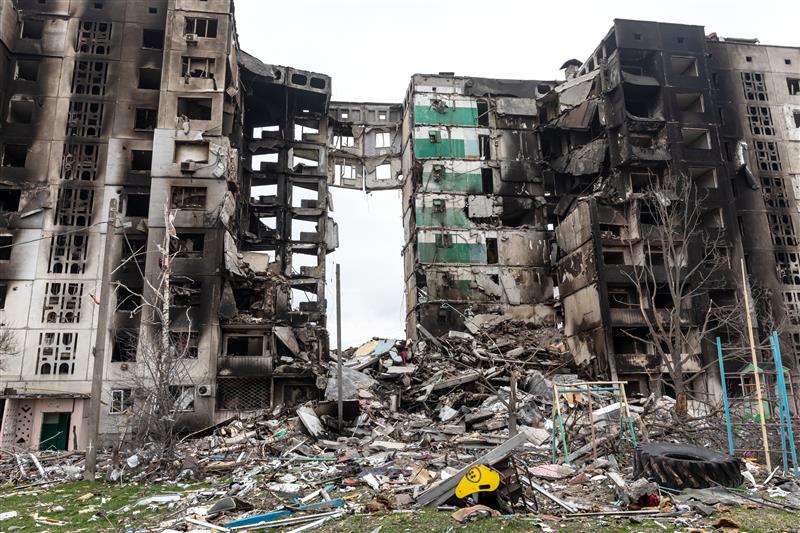
This panel will examine issues related to human rights and the potential for transitional justice in the context of Russia’s invasion of Ukraine and the ongoing Russian-Ukrainian war.
- Date(s)
- March 4, 2026
- Location
- Main Site Tower - Boardroom (09.022)
- Time
- 13:00 - 15:00
We will be joined by three speakers and their presentations will be followed by time for questions and discussion.
Margaryta Khvostova (University of Surrey):Human Rights and Democratic Resilience in Hybrid Warfare: The Case of Ukraine, 2014-2022.
Margaryta Khvostova is a PhD candidate in Politics at the University of Surrey, affiliated with the Centre for International Intervention and the Centre for Britain and Europe. Her doctoral research examines human rights as a source of legitimacy in frontline communities in Donbas since 2014. She holds an MA in Culture, Media and Society (Lancaster University) and an MA in International Relations (Coventry University). Her research interests include human rights, hybrid warfare, securitisation, and democratic resilience under conditions of war. She has published on human rights and wartime governance, and has worked with the European Council on Foreign Relations, the UK Civil Service, and Ukrainian civil society organisations.
Dr Kateryna Busol (National University of Kyiv-Mohyla Academy):Transitional Justice for Ukraine: Myths and Ways Forward.
Dr Kateryna Busol is a Ukrainian lawyer. She is an Associate Professor at the National University of Kyiv-Mohyla Academy, a British Academy Research Fellow at the British Institute of International and Comparative Law and a Legal Advisor to the International Centre for Transitional Justice. As a practicing lawyer and scholar, Kateryna has worked on conflict-related sexual violence, crimes affecting cultural heritage, direct and public incitement to genocide, reparations and Ukraine's transitional justice process. She has worked with UN Women, Global Rights Compliance and Truth Hounds and advised Ukrainian prosecutors and judges on armed conflict-related proceedings. Kateryna was a fellow at Chatham House and a visiting professional at the ICC Office of the Prosecutor.
Dr Andrew Forde (Dublin City University):The Council of Europe - An Emerging or Consolidating Transitional Justice Actor?
Dr Andrew Forde is Assistant Professor of European Human Rights Law at Dublin City University (DCU) and Commissioner on the Irish Human Rights and Equality Commission (IHREC). He worked for the Council of Europe and the Organisation for Security and Cooperation in Europe for more than a decade as Human Rights Advisor to the Council of Europe Commissioner for Human Rights and Political Advisor with a particular focus on human rights in conflict-affected regions. During this time he led Council of Europe operations in Kosovo for 5 years as well as confidence-building measures in Bosnia and Herzegovina. He spent six years as a Principal Officer in the Irish civil service managing major rural development and social enterprise policies and budgets, before becoming a full-time academic. His first bookEuropean Human Rights Grey Zones - The Council of Europe and Areas of Conflict was published in 2024 by Cambridge University Press and won the 2025 Kevin Boyle Book Prize for Outstanding Legal Scholarship. His second, co-authored book on Russia's relationship with the Council of Europe (Bristol University Press) was published in February 2025. He is co-founder of the AGORA Group, an independent, pan-European platform committed to open dialogue and balanced, evidence-based debate on key issues concerning the European Convention on Human Rights (ECHR).