
Parks Shouldn’t Be Scary: The Hidden Link Between Safety and Women’s Health
In this blog, Kassy Price explores how safe, well-designed green and blue spaces can transform women’s health; supporting safety, wellbeing, and maternal outcomes in powerful but often overlooked ways.

The health benefits of green and blue spaces should be available to everybody, yet some women avoid public parks due to fear of harassment or violence. When women and girls don’t feel safe outdoors, they lose access to the peace and restoration that nature should offer to everyone. They lose access to socialising, to breathing fresh air and watching wildlife. They also lose access to exercise. Outdoor spaces help us to stay active, which supports physical and mental wellbeing, but if a woman’s local park is dangerous, the benefits of nature become out of reach. Violence against women and girls in public spaces (VAWG) is under-researched and over-looked, and cases can be difficult to prosecute.
Green and blue spaces can be quiet, and when passing through them, there are moments when you are suddenly all alone. This feeling, though tranquil to some, can be frightening for others. Tall, dense bushes near pathways and low lighting can also make outdoor areas feel intimidating. So what is being done to tackle this, and make public spaces inclusive and accessible for all?
In June 2025, Groundswell researchers from Queen’s University Belfast held a series of workshops in the community, to discuss the ways in which public spaces could be made safer for women and girls. A survey from Northern Ireland showed that 98% of women aged 18 and older, and 73% of girls ages 12-17 have experienced at least one form of violence in their lifetime. 16% of those women and girls said their worst recalled violent event was in a public space such as a park, forest, the street or public transport. Researchers wanted to know how the public use outdoor spaces and the attitudes, behaviours and social and cultural norms which perpetuate VAWG in Belfast. There were forty-five participants, of diverse ages, genders and backgrounds and each was given the chance to discuss practical solutions on how to stop VAWG in outdoor spaces.
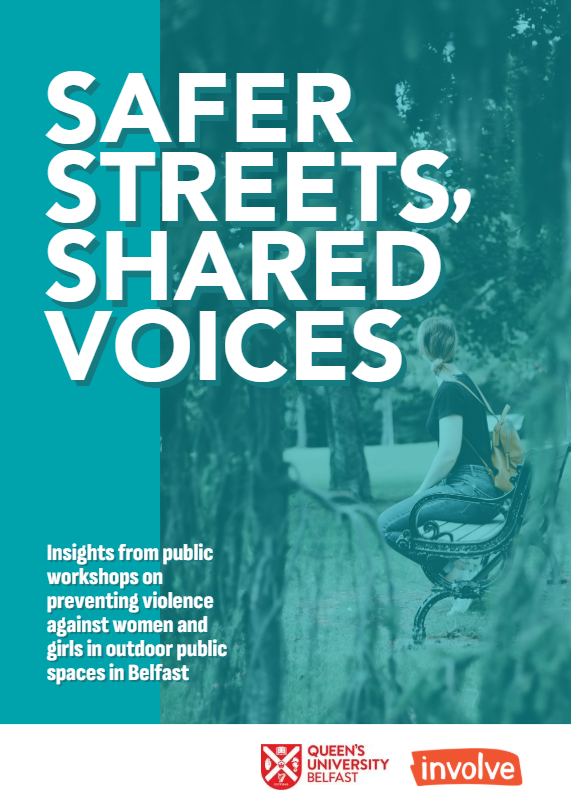
You can read the full report from the workshops here.
Participants shared their experiences, commented on proposed solutions and came up with their own ideas too. Once changes come into place, women in Northern Ireland will hopefully feel more confident and comfortable outdoors. The forty-five participants were put into four groups; women, men, young women (16-19) and young men. The women provided their lived experiences and suggestions such as women-only spaces and better policing. The young women talked about empowering themselves; learning self-defence, and the bad side of too much surveillance. The men focused on solving the problem, by educating and mentoring younger generations. The young men highlighted education and the need for clearer information about what to do when somebody feels unsafe. A lot of emphasis was on how attitudes must be challenged and the ways in which to educate people, to prevent VAWG in the future. It was noted, however, that this would take time. Something that can have a more immediate effect though, is to redesign outdoor spaces, which can improve safety sooner rather than later.
The four groups agreed that a well-designed outdoor space can immediately make women and girls feel safer, and deter perpetrators. In many parks, better lighting is needed. Lights deter offenders, and more streetlights should be installed, especially in narrow and tucked-away areas. The workshops also discussed the installation of sensors, public panic buttons, emergency phones and smart lights. Clear sightlines are a simple but powerful way to make a park feel safer. Wider paths and gaps between trees create more open areas and better visibility. Multiple exits and better entrance and exit routes are helpful in making people feel safe, and are practical too. Some suggested more CCTV, but others felt that the negative consequences of surveillance outweigh the positive. Cameras deter perpetrators and support investigations when incidents occur, and many women feel safer when they are there. But some argued that cameras in natural spaces can feel intrusive or change how people use them.
Encouraging a community presence in green and blue spaces is a sure way to prevent VAGW, and the key to this is good maintenance. Neglected spaces are shown to have more violence than well-kept ones, because less people use them, and less people means more opportunity for crime. It was also noted that changes mustn’t disrupt the existing biodiversity. The goal is not to strip back nature, but to design landscapes that support wildlife, while reducing violence. For instance, using smart lights and motion sensors would limit constant illumination, protecting nocturnal animals, and when overgrown vegetation next to paths is cut back (this is shown to be somewhere that violence takes place), it could be replaced with low bushes and flowers.
A Success Story
Around the UK, similar projects have been taking place, with communities rallying together to improve their parks.
A community project in Wavertree, Liverpool, has recently made changes to their local park which align with the design principles discussed in the Belfast workshops. While the project wasn’t gender-based, they have had success in reducing crime, which shows that these principles do work, and can improve safety for women. The Mystery Park had experienced anti-social behaviour and violent incidents. Residents complained about the park's decline saying it was unsafe, especially one particular path which was completely overgrown. Locals, especially the elderly, no longer used it out of fear. So The Hotspot Response Fund, Merseyside Police, and local recovery charity Damian John Kelly House, held community discussions with a focus on male identity and violence. There were theatre performances delivered to local schools and families, and schoolchildren planted flowers, increasing biodiversity to attract more people (and wildlife) to the park.

The Mystery Park, Liverpool.
Clean-up days were held, and the vegetation growing wild around the disused path was cut back to create a safer space. A bench, artwork and flower boxes were placed next to the path which has now been called ‘Community Corner.’ The Mystery’s regeneration leaned heavily on the idea of clear sightlines by improving the problem pathway, and making it welcoming. It’s a big part of why people now feel more comfortable using an area they once avoided, and with more of a community presence there, it is safer.
Maternal Health and Connection to Nature
Women's avoidance of parks is a public-health concern, especially when we consider perinatal women and the advantages nature has on them. The perinatal period is one of excitement, but comes with challenges too. As well as the physical toll it puts on the body, it can be daunting with all of the new responsibilities to consider. Pregnant and post-partum women have an increased risk of poor mental health. With fluctuating hormones influencing their brain chemistry, they are vulnerable to stress and mood swings. Perinatal depression affects 10-20% of women. The transition to parenthood can also mean a decline in physical activity and less leisure time. After having a baby, it’s easy to slip into a sedentary lifestyle and stay indoors more, which can have a further negative effect on mental health.
Concern is growing that the NHS can’t keep up with the rise in poor mental health, but research shows that a nature-based intervention could be the answer. Can the great outdoors play a role in enhancing the wellbeing of perinatal women and their babies?
I spoke to Groundswell researcher Rukun Khalaf, about nature's impact on perinatal women. By looking at studies from across the world, Rukun concluded that exposure to nature can influence the biological development of babies in the womb. For women who surround themselves with greenness, there is a reduced risk of complications during pregnancy. Their babies are bigger, they are less likely to suffer from gestational diabetes, and less likely to give birth prematurely. Being born premature can have a lifelong effect on health, so a way to prevent this would be life-changing for many. It is thought that exercise factors into these discoveries; nature goes hand in hand with exercise, and exercise boosts the health of mums and babies. There is also evidence to show that air pollution can have an adverse effect on growing foetuses. The less a pregnant woman is exposed to the pollutants common in urban environments, the better it is for her baby.
When it comes to the effect nature has on mums and mums-to-be, the topic needs more research, but we know that being outdoors relieves stress, lowers blood pressure, improves mood and provides better opportunities for socialising and exercise. Being surrounded by nature is also linked to improved sleep…something that is especially important for new mums! Here in Liverpool, there are opportunities for women to meet outdoors in groups. Mamafit offers a range of exercise classes both indoors and outdoors, in various parks across Merseyside and the Wirral, and for those who don’t feel up to swinging kettle bells about, there are free ‘Walk and Talk’ buggy walks. Groups like these are really important for women who might feel isolated after giving birth, and would like to make new friends in the same situation as they are.
Laura and Sarah are both first-time mums. I met with them in blue and green space, Sefton Park, Liverpool to talk about their exposure to nature pre and post pregnancy, and what makes an outdoor space feel safe to them. While she was pregnant, Sarah, who is a nurse, spent lots of time in parks near her house.
“I went to Park Run for as long as I could. Towards the end I had to stop because it was getting too hard to run. It just makes you feel good doesn’t it? Keeping fit helps you with the birth as well.”
“It’s a coastal reserve, so on my lunch hour I walked there everyday. You’re at the waterfront, there’re birds of prey and other wildlife. It made a real difference being able to get out. It boosts your mood.”
- Laura, who works by the estuary in Speke.

Laura and Sarah out on a rainy walk in Liverpool.
Both gave birth to healthy babies and said that natural surroundings are helping them to bond with them. Things are more interesting outside. There are dogs to point out, different flowers, and birds splashing in the lake.
“You’re showing them round places that you went to when you were little. I know they won’t remember it yet but eventually they will. You’re talking to them and they’re facing you in the pram, and it shows them a different side, instead of being stuck in the house."
“I get out every day and usually go to Sefton Park. I wouldn’t come after dark or go into the middle of the park at night, but in the daytime I feel safe.”
“What makes me feel safe is when I walk down Grassendale Esplanade, there are a lot of houses with ring doorbell systems, and they might be a bit invasive, but at least you’re being seen. There are people walking their dogs too, and other mums with kids. It’s exposed. I do try to go to exposed places where there’s lots of people around. I have a background in martial arts so I can defend myself but as I’ve got a pram, I still feel vulnerable.”
- Sarah, who's son was four days old when she took him out for the first time.
“I couldn’t wait because I hate being in the house all the time. I needed to get out, I thought, I’m going mad!”
Sarah said that nature helped with her mood, stress-levels and mental health, pre and post pregnancy. Going outside calms her baby down which in turn calms her down.
“It can feel isolating when you can’t get out with them and they’re in the house screaming,”
“It’s good for their wellbeing, being able to get fresh air. It helps them to sleep better. Even before I had her, I’d get out and it would improve the quality of my sleep.”
- Laura.
Newborns don’t have a bodyclock and don’t produce melatonin until they are three months old, but natural light helps them to recognise daylight patterns. Over time this leads to better sleep and better sleep patterns - a win for both mum and baby!
Laura and Sarah’s reflections show that access to safe, welcoming parks, waterfronts and other outdoor areas isn’t and shouldn’t be a luxury. It’s a lifeline for perinatal women. It supports mental health, combats isolation and aids in babies development and sleep, all while giving them precious time spent with their mum. Time outdoors in nature is priceless, offering connection in a period that feels overwhelming to some. It is important to prioritise these shared spaces, because for many families they are not just places to pass through, but places to grow.
“You know what? Talking about this has made me realise how lucky we are to have all these green spaces.”
- Laura.
Sources
Safer Streets, Shared Voices https://groundswelluk.org/Filestore/Safer%20Streets%20Shared%20Voices.pdf
Preventing VAWG in Outdoor Spaces in Belfast: A Systems Map
https://groundswelluk.org/Filestore/Preventing%20violence%20against%20women%20and%20girls%20in%20outdoor%20public%20spaces%20in%20Belfast%20-%20A%20systems%20map.pdf
Community-led project to regenerate Mystery Park reaches completion
https://theguideliverpool.com/community-led-project-to-regenerate-mystery-park-reaches-completion/
The Impact of Green Space on Violent Crime in Urban Environments: An Evidence Synthesis
https://www.qub.ac.uk/sites/groundswell/Filestore/SMJSlides131025.pdf
The role of green and blue spaces in perinatal maternal mental health outcomes during the transition to parenthood
https://www.sciencedirect.com/science/article/pii/S016041202500323X
Mamafit
https://mamafituk.com/
The First 1000 days: Window of Opportunity for Child Health and Development
https://pmc.ncbi.nlm.nih.gov/articles/PMC12400855/
The role of light exposure in infant circadian rhythm establishment: A scoping review perspective
https://pmc.ncbi.nlm.nih.gov/articles/PMC11685245/
Kassy Price, Community Blogger
Media
groundswell@qub.ac.uk