
Top
Skip to Content
LOGO(small) - Queen's University Belfast
  • Our facebook
  • Our linkedin
  • Our youtube
LOGO(large) - Queen's University Belfast

The Institute For Global Food Security

  • Home
  • Research
    • Nutrition and Preventive Medicine
    • Enabling Technologies, Data and Data Innovation
    • Food Integrity
    • Agriculture & Environmental Resilience
    • Research Impact
    • Research Culture
    • Research Environment
    • Recent Research Outputs
    • Postgraduate Research
  • Partnerships (including EIT Food)
    • Queen's-AFBI Alliance
  • Contact
    • Researchers and PhD supervisors
    • Key Contacts
    • Laboratory Staff
  • News
    • News Archive 2023
    • News Archive 2022
    • News Archive 2021
    • Covid-19 and Food podcast
    • News Archive 2020
    • News Archive 2019
    • News Archive 2018
    • News Archive 2017
    • News Archive 2016
  • Facilities (including ASSET lab)
  • Events
  • Media
  • Home
  • Research
    • Nutrition and Preventive Medicine
    • Enabling Technologies, Data and Data Innovation
    • Food Integrity
    • Agriculture & Environmental Resilience
    • Research Impact
    • Research Culture
    • Research Environment
    • Recent Research Outputs
    • Postgraduate Research
  • Partnerships (including EIT Food)
    • Queen's-AFBI Alliance
  • Contact
    • Researchers and PhD supervisors
    • Key Contacts
    • Laboratory Staff
  • News
    • News Archive 2023
    • News Archive 2022
    • News Archive 2021
    • Covid-19 and Food podcast
    • News Archive 2020
    • News Archive 2019
    • News Archive 2018
    • News Archive 2017
    • News Archive 2016
  • Facilities (including ASSET lab)
  • Events
  • Media
  • Our facebook
  • Our linkedin
  • Our youtube
In This Section
  • News Archive 2023
  • News Archive 2022
  • News Archive 2021
  • Covid-19 and Food podcast
  • News Archive 2020
  • News Archive 2019
  • News Archive 2018
  • News Archive 2017
  • News Archive 2016

  • Home
  • News

News

Midges surviving extreme cold conditions may contribute to future bluetongue outbreaks, new research

23 February, 2026

New research led by Queen’s University Belfast reveals that biting midges, the insects responsible for transmitting bluetongue virus, can survive colder temperatures than previously thought, having implications for the overwintering of the virus.
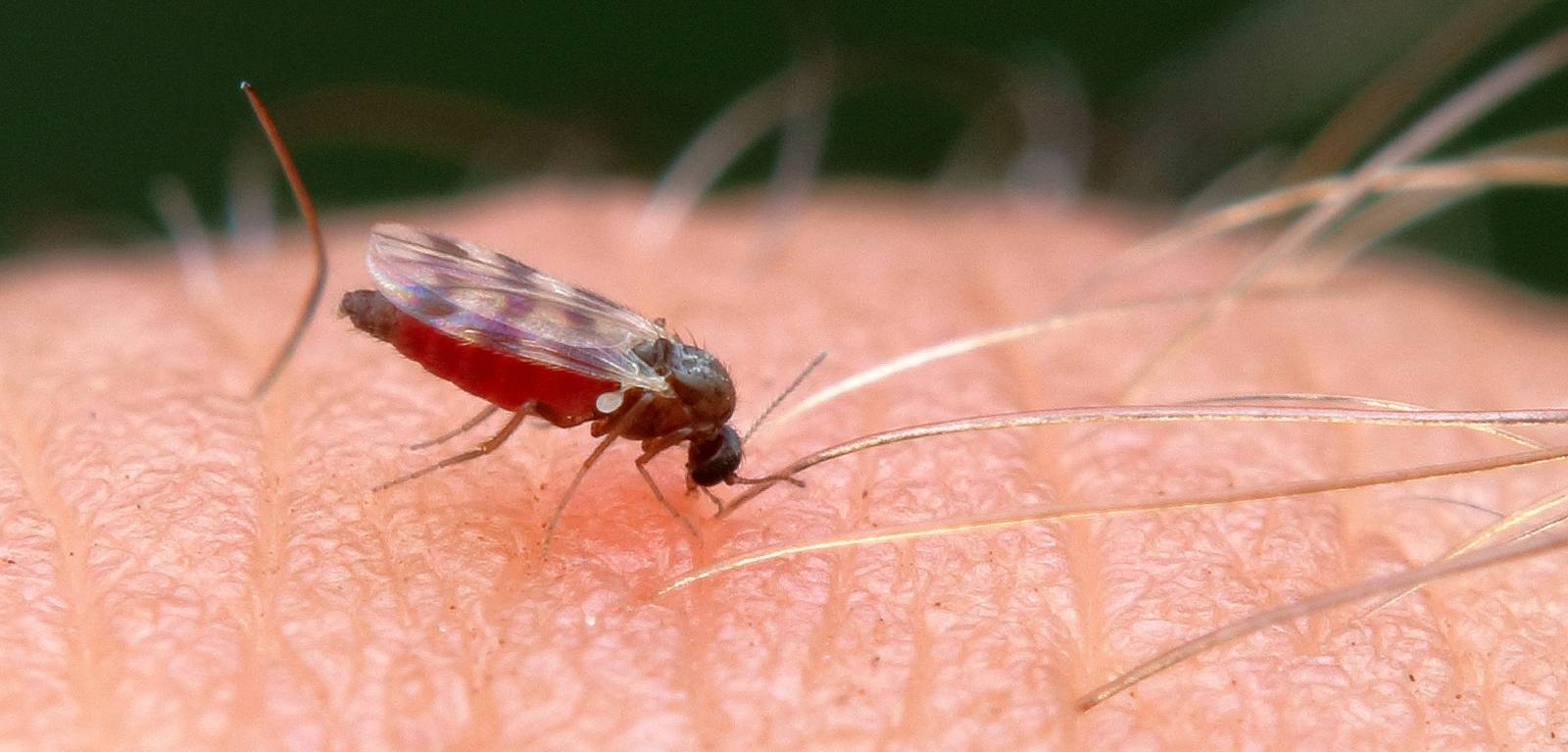
insect on a humans hand

Published in the Journal of Medical Entomology, this global study, in collaboration with The Pirbright Institute, is the first to quantify cold tolerance across every life stage of a Culicoides biting midge.

Midges can transmit several economically devastating livestock diseases, including bluetongue virus, African horse sickness virus and Schallenberg virus.

The study tested midges at all stages of their life cycle, from eggs to larvae, pupae and adults, under short and prolonged cold exposure. The results show that the eggs survived temperatures as low as −18 °C, the lowest temperature achievable with the experimental system, and may tolerate even colder conditions.

Lead author of the study, Lucy Devlin, is a PhD researcher from the School of Biological Sciences and Institute for Global Food Security at Queen’s, she said:

“Our findings help explain how these species can survive even in the coldest of months, and at temperatures lower than previously assumed.

“Our research is particularly timely as it follows the re-emergence of bluetongue across northern Europe in recent years, and its first recorded outbreak in Northern Ireland in late 2025, the first on the entire island of Ireland. Northern Ireland is particularly vulnerable due to its high livestock density and strong dependence on livestock production and export, meaning even limited outbreaks can have wide-ranging economic impacts.”

The virus primarily affects sheep, cattle, goats and camelids, with outbreaks resulting in livestock movement restrictions, trade disruption, animal welfare concerns, additional pressures on veterinary and animal health services, and economic losses to farmers.

Dr Ross Cuthbert from the School of Biological Sciences and Institute for Global Food Security at Queen’s added:

“This research provides critical biological evidence needed to improve vector-borne disease forecasting models and to refine assumptions used in climate-disease risk modelling. It is crucial information that will help inform UK and European surveillance strategies and support government agencies and veterinary services in preparedness planning.

“By identifying which life stages are most cold-tolerant, our study helps explain how midges might overwinter. Ultimately, this work contributes to protecting livestock health and farmer livelihoods, while advancing food security and supporting rural economies across the UK and Europe.”

This research, which was funded by the Department of Agriculture, Environment and Rural Affairs (DAERA), Northern Ireland, and BBSRC, was a collaboration between Queen’s, The Pirbright Institute and the Agri-Food and Biosciences Institute (AFBI).

Media

For media enquiries, please contact Grace White at Queen’s Communications Office: g.white@qub.ac.uk

Share
Latest News
  • Sofina Foods CEO Delivers 2026 George Scott Robertson Memorial Lecture
    3 March, 2026
  • Midges surviving extreme cold conditions may contribute to future bluetongue outbreaks, new research
    23 February, 2026
  • Three servings a day - the fruit habit that could boost your mood
    28 January, 2026
  • Lethal pandemic disease slowing down the extinction of amphibians in tropical climates, study shows
    23 January, 2026
  • Queen’s student makes new discovery on Strangford Lough
    22 January, 2026
News
  • The Institute for Global Food Security
  • News Archive 2023
  • News Archive 2022
  • News Archive 2021
  • Covid-19 and Food podcast
  • News Archive 2020
  • News Archive 2019
  • News Archive 2018
  • News Archive 2017
  • News Archive 2016
QUB Logo
Contact Us

Institute for Global Food Security
Biological Sciences Building
19 Chlorine Gardens, Belfast
BT9 5DL

Email: sbsigfsoffice@qub.ac.uk
Tel: +44 (0)28 9097 5787

Quick Links

  • Home
  • Research
  • Study
  • Partnerships


© Queen's University Belfast 2024
  • Privacy and cookies
  • Website accessibility
  • Freedom of information
  • Modern slavery statement
  • Equality, Diversity and Inclusion
  • University Policies and Procedures
Information
  • Privacy and cookies
  • Website accessibility
  • Freedom of information
  • Modern slavery statement
  • Equality, Diversity and Inclusion
  • University Policies and Procedures

© Queen's University Belfast 2024

Manage cookies