Engineering Design for Net Zero

OUR MISSION:
To create new knowledge and capabilities to accelerate the design of next-generation products.
Importance
Achieving Net Zero will require significant changes to sustainable transport and propulsion systems. Engineering design is critical to deliver this transformation, enabling the development of innovative, sustainable solutions that minimize environmental impact while ensuring performance and reliability. Our research is dedicated to advancing design, simulation, and optimisation methods to create products that support a carbon-neutral future. By integrating cutting-edge methodologies with a focus on sustainability, we aim to drive the engineering advancements necessary to meet global Net Zero goals.
RESEARCH FOCUS
Design Methods & Systems
Innovative techniques such as bio-inspired design and data-driven design to create efficient, high-performance engineering solutions.

Design for ‘X’
Tailored simulation and design approaches to tackle specific requirements and challenges, such as ease of manufacture or structural integrity under extreme scenarios
Modelling & Optimisation
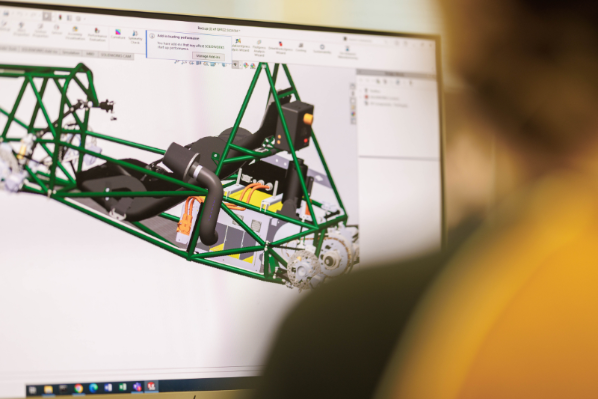
Intelligent and efficient multiscale and multiphysics simulation frameworks for design optimisation
-600x399.png)
Technology Impact Forecasting
Evaluating how emerging technologies reshape product design processes and solutions, enabling forward-thinking strategies for innovation and implementation.
FUNDING PORTFOLIO:
We have led or participated in multiple EPSRC, BBSRC, and ATI-funded projects—including programme grants, fellowships, hubs, and network initiatives—totalling over £45 million in overall project value.
Our current live funding portfolio includes:
- Programme grants: RIED (EPRSC, 2021, Lead: QUB, Total value = £7.3M); REMODEL (EPSRC, 2025, Lead: Swansea, QUB value:£1M, Total value = £6.3M)
- Prosperity Partnerships: VECTA (EPSRC, 2025, Lead: Edinburgh/RR, QUB value:£1.3M, Total value = £16.5M)
- Hubs: Advanced Metrology Hub (EPSRC, 2024, Lead: Huddersfield, QUB Value = £560k, Total value = £24.3M)
- Individual Fellowships: DECIDE for Net Zero (EPSRC, 2024, Lead: QUB, Total value = £1.9M)
- Network Plus: Digital Design Network Plus (EPSRC, 2025, Lead: QUB, Total value = £1.7M), RiSC+ (BBSRC, 2024, Lead: QUB, Total value = £6.4M)
- ATI projects: TARGET-H2 (2024, QUB value = £560k), TARGET-H2 (2025, QUB value = £500k), Digital Design Transformation (2025, QUB value = £2.2M),
- UKRI: Project STARLITE (2025, £250k) - developing MEMS sensors for aviation, space and biomedical applications
- Commercially funded research with BVI Medical: Project VELVET (2025, £720k) - understanding the complex fluid dynamics during eye surgery to improve engineering designs and surgical outcomes
- In addition, at any time, we have multiple industry awards and have 10-20 active industry-funded PhDs.
Overview
In partnership with leading UK companies (e.g. Rolls-Royce), we are developing design & computational modelling capabilities to support mechanical excellence, enabling early, rapid and ‘in context’ structural design. We lead a £7.4m EPSRC UK-wide consortium, Re-Imagining Engineering Design: Growing Radical Cyber-Physical-Socio Phenotypes. Our goal is to transform design engineering through interoperable cyber-physical-social services.
The team includes an EPSRC Fellowship, which is investigating novel ways of understanding constraints in Engineering Design. The Fellowship project (£1.9m), entitled “Dealing with Evolving Constraints in Design Systems for Net Zero (DECIDE for Net Zero) is focused on net zero flight.
RIED
Re-Imagining Design Engineering.
The fundamental goal of this proposal is to Re-Imagine Design Engineering so that new ideas and concepts are generated rapidly, and where both the product and its associated manufacturing system (including its supply chain and people) are designed concurrently and fully tailored to each other. Taking inspiration from nature RIED is a concept generator that can very rapidly create a range of concepts for complex engineering structures such as aircraft wings.
Read more Read less
Digital Design Network Plus
Designing Faster and Better with Less
This network aims to create an active digital design community that will define, set and prioritise key Engineering Design challenges and viable solution pathways that will exploit digital design technologies and help UK engineering transition to net zero faster.
Read more Read less
DECIDE for Net Zero
Evolving Design for Net Zero
In DECIDE for Net Zero, constraints will be permitted to evolve just as every part of the design can. In doing this, the design context itself will evolve, creating new fitness landscapes for product evolution. Contrary to standard practice today, which is to optimise as far as possible, the aim here is to generate a diverse population of solutions that will have many individuals that survive major disruptions, even if some may fail. This is moving significantly beyond current concepts of robust design.
Read more Read less