

2015
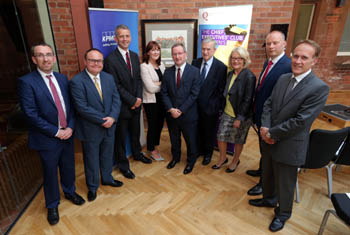
(L-R) Professor John Turner, Dr Graham Brownlow, Eamonn Donaghy, Angela McGowan, Professor Patrick Johnston, John Simpson, Dr Wendy Austin MBE, Richard Ramsey, Jon D'Arcy
On 23rd June 2015 the Chief Executives’ Club at Queen’s and Queen’s Management School (QMS) hosted a debate (supported by KPMG) entitled: ‘The Northern Ireland Economy debate: how to build a vibrant and sustainable economy’. The chair was Wendy Austin MBE, presenter of BBC Radio Ulster’s ‘Inside Business’. Approximately 280 people attended the debate and the audience included key opinion formers, business leaders and politicians. A welcome to the debate was provided by Professor Patrick Johnston, President and Vice-Chancellor of Queen’s University Belfast. The panel members were Eamonn Donaghy, Head of Tax at KPMG; Angela McGowan, Chief Economist, Danske Bank; Richard Ramsey, Chief Economist, Ulster Bank; John Simpson, former academic economist at QUB and Dr Graham Brownlow, Lecturer in Economics in the School and a Research Associate within the Queen’s University Centre for Economic History (QUCEH).
A wide range of economic topics were covered during the debate. While there was a wide range of views expressed, there was equally a significant degree of consensus. For example, Mr Simpson, Mr Donaghy and Ms McGowan all expressed the view that a UK exit from the EU would be damaging to the region’s economy. Dr Brownlow observed that the economics of national identity cannot be reduced merely to the ‘economic’ aspects of EU membership. Rationality cannot be merely reduced to output. There was equally consensus also that social marginalisation and educational disadvantage held back Northern Ireland in both economic and socio-political terms. Ms McGowan, Mr Simpson and Mr Ramsey all noted the serious problems of educational and/or skills quality. There was however less consensus on the issue of rebalancing. While Mr Donaghy argued that the Northern Irish economy suffered from an excessively large public sector, Dr Brownlow observed that empirical evidence showed that successful Nordic economies were able to reconcile a large public sector with sustained excellent economic performance. He observed that research indicated that what really set Northern Ireland apart was the poor performance of its exporters rather than a large public sector. Likewise, while Mr Donaghy and Ms McGowan argued that reducing the relative rate of Corporation Tax (CT) would act as a transformational measure for the Northern Irish economy, Mr Simpson and Dr Brownlow were much more sceptical. Indeed, Dr Brownlow observed that significant issues of institutional and policy design remained unanswered. He also noted that it was a pity that the Institute of Fiscal Studies had not been commissioned to assess the opportunity costs of reducing CT in Northern Ireland.
After the debate there was a question and answer session that covered a number of topics including the role of entrepreneurship, behavioural effects, compliance costs and political decision making and leadership. There was then a vote of thanks by Professor John Turner, Head of QMS and sponsors remarks by Jon D’Arcy, Chairman at KPMG, Belfast.