

2015

Dr Alan Fernihough
Do historical marriage patterns in Ireland predict the Troubles and the decline of the Protestant population outside Ulster? New research by Dr Alan Fernihough looks at mixed marriages that occurred across the Catholic-Protestant religious divide in 1911 Ireland, five years before the Easter Rising.
Fernihough, a Lecturer in Economics at Queen’s University Management School, found that mixed marriages in early 20th century Ireland were rare, accounting for less than 1% of all marriages. “This low number reflects local marriage market conditions, as well as ethno-religious hostility” says Fernihough.
Until recently, it would have been impossible to collect and analyse data on mixed marriages in Ireland. However, the digitisation of the 1911 Census of Ireland has created the opportunity to do so. “These data allow us to look at every married couple in 1911 Ireland, and pinpoint every declared mixed marriage. This is ‘big data’ meeting economic history,” Fernihough continues.
Stratifying their analysis by province, Fernihough, with co-authors Professors Cormac Ó Gráda and Brendan Walsh from University College Dublin, found evidence of a geographical split. Outside Ulster, mixed marriages were rare because of the relatively small Protestant population. But once an adjustment is made, by looking at the number of mixed marriages relative to the Protestant population in each province, mixed marriages are more common than they appear at first glance.
“This discrepancy underlines the importance of looking at marriage markets before using the incidence of mixed marriages as a yardstick for ethno-religious intolerance,” warns Fernihough. Irish Protestants outside Ulster had fewer opportunities to meet a partner of their own religious persuasion, and thus were more likely to compensate by marrying out. The opposite was true in Ulster, a result with far-reaching consequences, just at a time when competing orange and green nationalisms began to heighten fears and tensions and resulted in violent spill-overs.
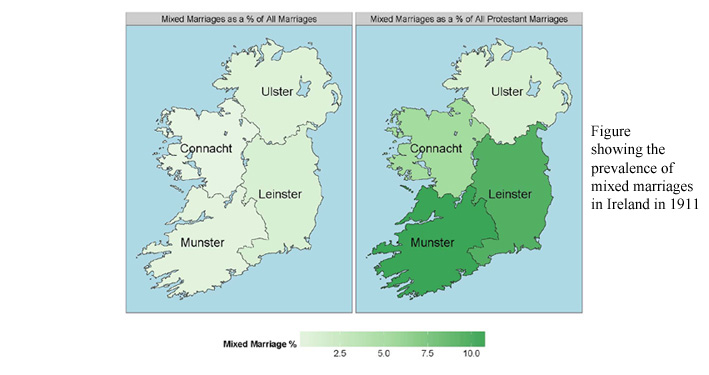
“Our results suggest a split was occurring early 20th century Ireland,” says Fernihough. Since they also have data on the family structure, Fernihough and his co-authors could identify the religious affiliation of the children born to mixed marriage couples. For the most part, the children born to mixed marriage couples outside Ulster were raised within the Catholic faith. Fernihough says that this result is consistent with the decline of the non-Ulster Irish Protestant population in the 20th century, where not only were Protestants more willing to marry across the religious divide, but they were also more likely to raise their children as Catholics.
Fernihough believes that these results have important implications for contemporary society, not only in Ireland but further afield. “Our methodology can also be used to explore tolerance across racial, ethnic and cultural divides”, says Fernihough. As societies become multicultural, the prevalence of intermarriage is a measure of tolerance and integration. Irish historical evidence suggests a link between infrequent intermarriage and a broader polarisation between communities, with potentially tragic consequences.
The full text of Fernihough’s research is available on the website of the journal Explorations in Economic History.
About the Author
Dr Alan Fernihough is an economic historian with research interests in demography and economic growth. He is a Lecturer in Economics at Queen's University Management School (QUMS), and a Research Associate at Queen's University Centre for Economic History (QUCEH). He can be reached by email on a.fernihough@qub.ac.uk.
Media Impact
Coverage in the Irish Times, 30 January 2015.