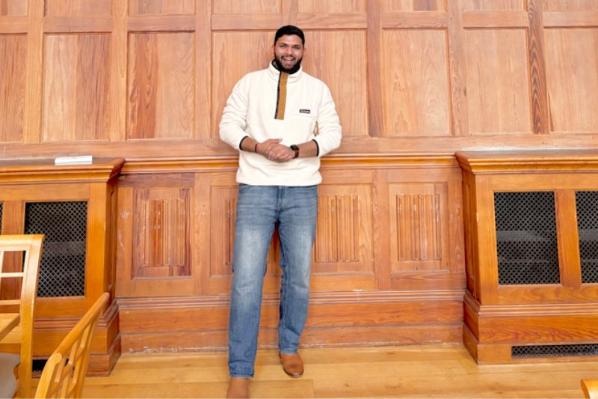

Postgraduate: Apoorve Chauhan's Experience Studying at Queen's Business School
Meet Apoorve Chauhan, a recent MSc Marketing graduate.
Why did you decide to undertake postgraduate study at Queen's University?
So, when I first started thinking about postgraduate study, I'll be honest, I had a list of about eight or nine universities. I thought I'd just compare the course modules, see which one ticked the most boxes and that would be it. Pretty straightforward, right?
But then I started digging deeper into Queen's, and something shifted. I was on the website late one evening, just browsing through the marketing department, and I clicked on one of the professor's profiles. I think it was out of curiosity more than anything. I started reading about their research, and it was actually interesting. Like, properly interesting. So I clicked on another profile. Then another.
Before I knew it, I'd gone down this rabbit hole, reading through their publications, their recent projects, what they were working on. And I remember thinking, 'Wait, these aren't just academics ticking boxes. They're doing work I actually want to learn about.' Consumer psychology, brand strategy, how digital marketing is evolving. It was all there.
Then I started reading student reviews and testimonials. People kept mentioning how approachable the professors were, how they'd actually sit down and discuss ideas with you, not just lecture at you. That stuck with me because I didn't want to spend a year in some massive program where I'm just another face in the crowd.
The more I researched, the more Queen's kept coming back to the top of my list. I looked at Belfast too. Watched a few videos, read about the city. And I liked what I saw. It felt like a place that's growing, where things are happening, but it's not overwhelming like London or somewhere massive.
By the end of it, my list of eight universities had basically become one. It wasn't even a difficult decision anymore. Queen's just felt right. The faculty, the research, the environment, everything. It stopped being about which university checked the most boxes and became about where I genuinely wanted to spend the next year of my life learning and growing. So yeah, that's why I'm here. It was a bit of a journey getting to that decision, but I'm glad I took the time to really figure it out."
Why did you choose to study this MSc Marketing programme?
I remember reading Philip Kotler's definition that marketing is about understanding people's needs and creating value for them and thinking, 'Oh, this isn't about tricking people into buying stuff.' It's actually about solving problems and making connections. That shifted everything for me and made me realise it's how vast marketing is.
How has this course helped towards, or shaped, your future career goals?
When I started the course, I'd already been working in sales and marketing for a bit, so I figured I had a decent handle on things. I mean, I knew how to talk to clients, close deals, understand what makes people tick when they're deciding whether to buy something. The day-to-day stuff? I was comfortable with that. But looking back now, I realize I was only seeing one piece of the puzzle.
The course changed that pretty quickly. We'd be in a lecture about consumer psychology or market positioning, and I'd suddenly think about a client meeting from six months ago and go, 'Oh, that's why they reacted like that.' Or we'd analyze a campaign strategy and I'd recognize patterns from things I'd seen work or fail in real situations. It was like everything I'd been doing instinctively suddenly had a framework behind it.
What really clicked for me was understanding that sales and marketing aren't these separate worlds. They're connected. Marketing sets the stage, sales brings it home. Once I saw how they fit together, it completely changed how I approached both. I wasn't just thinking about my part anymore. I could see the whole picture.
The course also opened my eyes to parts of marketing I'd never really dealt with before. Analytics, proper strategic planning, how to actually read market research instead of just skimming it. I'd always been more hands-on, in the field, talking to people. But now I understood what was happening behind the scenes, and that made everything make more sense.
Learning the software and tools properly was huge too. I'd used CRMs before, obviously, but really getting into analytics platforms and understanding how to use digital marketing tools the right way? That's been a game changer. I feel like I've got actual skills now, not just experience.
But honestly, the main thing is I know where I'm going now. Before, I was just kind of moving forward in the field without a clear destination. I knew I liked the work, knew I was decent at it, but that was about it. Now I can actually picture what I want. Whether it's moving into brand strategy, taking on bigger marketing roles, maybe even consulting down the line. I've got direction now instead of just momentum.
So yeah, it's been really valuable. Not just for what I learned, but for how it tied together what I already knew and showed me where I can take it next.
What were the highlights of your course and your time here at Queen's University?
"You know, when people ask about highlights, I feel like I could talk for hours because so much has happened. I remember my first few weeks here, just trying to find my way around campus, figure out where everything was, getting used to a completely new environment. It was a bit overwhelming if I'm honest. But then lectures started, and pretty quickly I realized this was going to be different from what I'd experienced before.
There was this one lecture early on where we were discussing consumer emotions and psychology. Not just the basics, but really getting into why people connect with certain brands, what drives their decisions beyond just logic. I was sitting there thinking, 'This is actually interesting.' Like, properly interesting. And then another time we spent an entire session breaking down Ryanair's marketing approach. On paper, it shouldn't work. They're almost antagonistic sometimes. But it does work, and understanding why was fascinating. Every lecture had these moments where something would click or I'd see something I'd never considered before.
The professors made a huge difference too. They weren't just delivering content and disappearing. They'd stick around after class, answer questions properly, actually engage with what we were discussing. I remember emailing one of them about something I was struggling with, and they responded the same day with this detailed explanation. That kind of support, it makes such a difference when you're trying to really understand something.
But honestly, some of my biggest highlights have been outside the classroom. A few months in, I became an International Student Ambassador. I didn't really know what to expect from it at first. I just thought it might be good to get involved in something. But it turned into one of the best decisions I made here.
Suddenly I was helping other international students who were going through exactly what I'd gone through. Answering their questions about accommodation, visa stuff, what life in Belfast is actually like. And you forget how confusing it all is until you're the one explaining it to someone else. Then I started working with prospective students as well, talking to people who were considering Queen's, sharing my experience. There's something really rewarding about being able to help someone make that decision, you know? Knowing that maybe you made their transition a bit easier.
Then there was the Splash project. That was completely different from anything else I'd been involved with. We were working with people with disabilities, actually getting our hands dirty helping them build accessible homes and play areas. I remember the first day showing up and thinking, 'Right, this is real work.' Not theoretical, not academic. Just genuine, practical work that makes a tangible difference to people's lives.
There was this moment during the project where we'd just finished building this play area, and seeing the people we'd been helping actually use it, seeing how much it meant to them. That stuck with me. It's one thing to talk about making a difference or helping communities. It's another thing entirely to be there and see it happening right in front of you.
And then something completely unexpected happened. I got featured on Dr. S. Jaishankar's social media. He's India's External Affairs Minister, quite a significant figure, and somehow my work as an ambassador got noticed and shared on his profile. I honestly couldn't believe it when someone sent me the screenshot. Seeing my photo there, my story being shared by someone at that level. It felt surreal. Like, proper recognition for the work we do as ambassadors. That was a moment I won't forget.
Throughout all of this, there were smaller things too. Meeting people from all over the world, making genuine friendships, exploring Belfast properly. Finding good coffee spots, going to events, just getting to know the city beyond the university. All of it adds up. Looking back now, it's been so much fun.
If you could give one piece of advice to potential applicants to the MSc Marketing programme, what would it be?
"Okay, so if you're thinking about applying or you've just gotten in, here's what I wish someone had told me before I started. First thing, and I mean this, don't come in thinking you've got it all figured out. I did that. I had this whole plan, thought I knew exactly what marketing was about, what I wanted to do with it. And then within a few months, everything I thought I knew got turned on its head. That's not a bad thing.
That's actually what should happen. So come in ready to have your assumptions challenged.
Second, and this is important, don't just do the academic stuff and call it a day. I'm serious. The lectures are great, the coursework matters, obviously. But if you're just showing up to class and going home, you're doing yourself a disservice. Get involved in things. And I don't mean force yourself to join everything, but when opportunities come up, actually consider them instead of automatically saying no because you're busy or tired or whatever.
I became an ambassador kind of on a whim. Didn't think it would be a big deal. Ended up being one of the best things I did here. Met loads of people, got experiences I never would've had otherwise, even got some unexpected recognition out of it. Same with the community projects. I wasn't planning on doing any of that, but someone mentioned it and I thought, why not? Turned out to be incredibly rewarding.
Here's the thing though, you've got to actually engage. Not just be there physically, but properly engage. Ask questions in lectures, even if you think everyone else already knows the answer. Stay back and talk to professors when something interests you. They're not scary, and they actually want to help. I spent way too long being intimidated before I realized they're just people who happen to know a lot about marketing.
Connect with other students too. Properly connect, not just group chat pleasantries. Some of my best insights came from random conversations with classmates who had completely different backgrounds or perspectives than me. International students especially, if you're local, talk to them. And if you're international, don't just stick with people from your own country. Branch out. Everyone's got something different to offer.
Also, Belfast. Actually explore it. Don't just stay on campus or in your accommodation. Find the good spots, go to events, get to know the city. It makes the whole experience feel less like you're just here for a degree and more like you're actually living somewhere for a year.
And look, this might sound obvious, but be open to changing your mind about what you want. I came in with very specific career goals. They shifted completely. I discovered interests I didn't know I had. That's not failure, that's growth. So don't lock yourself into one path on day one and refuse to budge. Let the experience shape you a bit.
Last thing, and maybe this is the most important bit. A year sounds like a long time when you start, but it goes so fast. Genuinely fast. Before you know it, you're writing your dissertation and wondering where the time went. So don't put things off thinking you'll do them later. If something interests you, do it now. If there's an event or opportunity, go for it. You don't get this time back.
So yeah, that's my advice. Come in curious, get involved, actually engage with people and opportunities, and don't waste time just going through the motions. Make the most of it while you're here, because it flies by."