
Introducing QCAP C4's Coordination and Embedded Research Team: Dr Gavin Brewis and Dr Neal Halforty
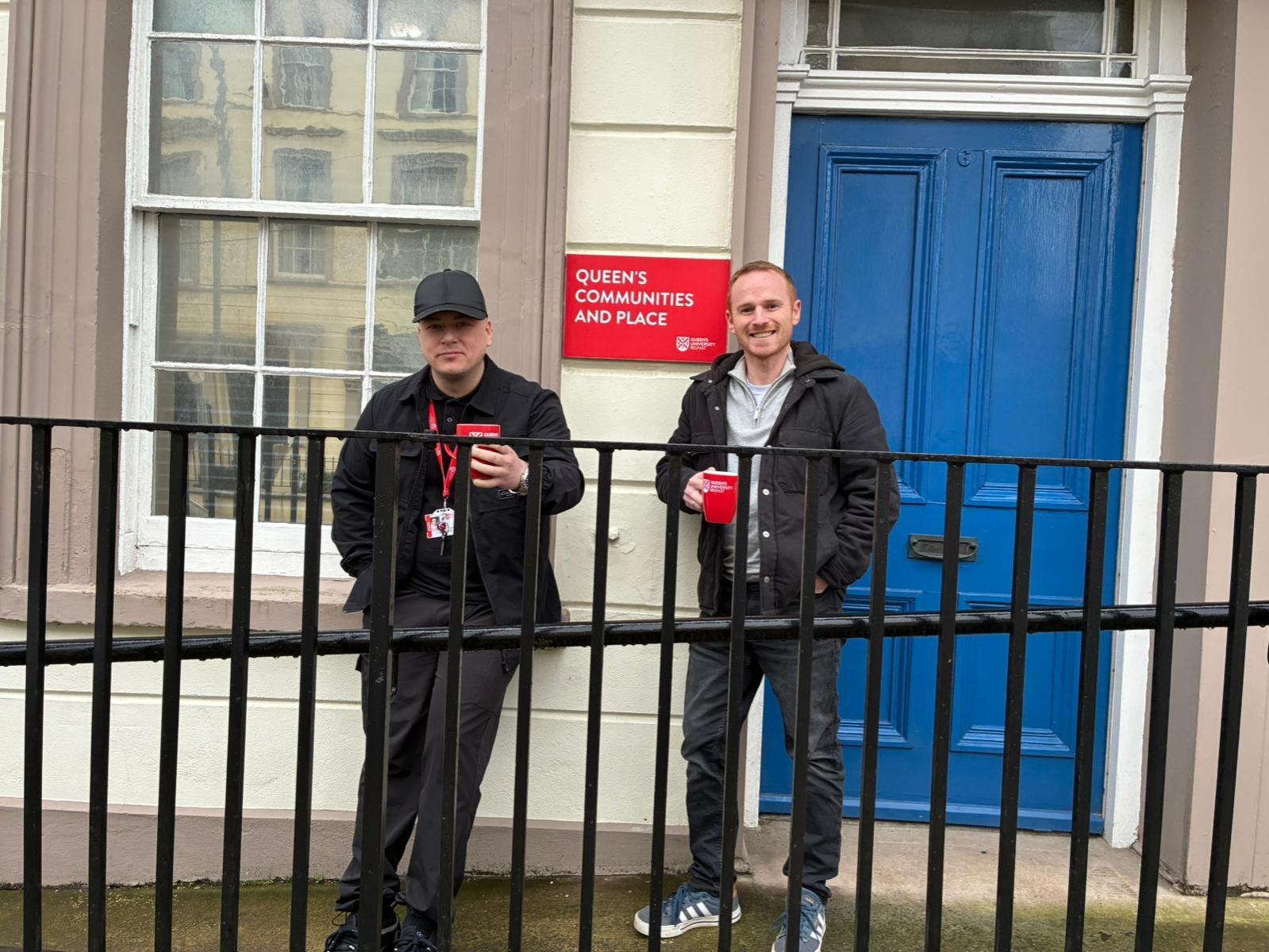
Dr Gavin Brewis — Research Fellow, Queen’s Communities and Place (QCAP) and C4 Community Catapult Coordinator
Dr Gavin Brewis is a Research Fellow with Queen’s Communities and Place (QCAP) at Queen’s University Belfast, and the Community Catapult Coordinator for the Centre for Collaboration in Community Connectedness (C4). His work is rooted in community engaged and collaborative research, with a sustained focus on how class relations, place, and inequality shape everyday life, culture, and the conditions communities are forced to navigate.
Dr Brewis’ research sits at the intersection of working class subcultures, political economy, and the institutions that regulate, narrate, and criminalise “problem” populations. Grounded in a neo dialectical and historical materialist approach, his work is particularly attentive to conjuncture. He examines how specific historical moments such as deindustrialisation, neoliberal restructuring, punitive governance, moral panic, and intensified policing condense into lived experience and shape cultural formation. Across his research, culture is treated as materially produced and socially organised, inseparable from the wider relations of power that structure the city.
He is best known for his scholarship on Neds and Ned Culture in Glasgow from around 1995 to 2008, which offers a critical social history of a subculture that has often been misrepresented or reduced to deviance. This work examines how belonging, territoriality, style, language, music, reputation, and everyday conflict were shaped within wider conditions of structural constraint and institutional intervention. His research has travelled beyond the academy and has featured in news coverage and wider public discussion. He is also scheduled to appear on the BBC's upcoming Ultras programme in March.
Dr Brewis has published widely across peer reviewed and public facing outlets, with a strong body of work on youth and subcultural studies, class and place, and the cultural and institutional dynamics through which moral panics are produced and mobilised. His wider writing has also engaged questions of punishment and confinement including debates around private prisons, and the longer run impacts of systemic violence across generations. Across these areas, his work consistently links cultural life to the structural forces that produce inequality.
He brings strong applied research experience across qualitative and mixed methods inquiry and has held research and community engagement roles with government prior to taking up his current post. He has worked with the Scottish Government and delivered invited talks for them, contributing to policy facing conversations on inequality, youth culture, and social justice. He has also delivered invited keynotes at international conferences, including on young people and education, bringing his expertise on class, place, and institutional power into debates that cut across academic and applied settings.
Through his roles at QCAP and C4, Dr Brewis works to strengthen inclusive research cultures that take community expertise seriously, support co production in practice, and build durable connections between local knowledge and institutional decision making.
Dr Neal Halforty — Research Fellow, Queen’s Communities and Place (QCAP) and C4 Embedded Researcher
Dr Neal Halforty is a Research Fellow with Queen’s Communities and Place (QCAP) at Queen’s University Belfast. His work is rooted in community-engaged and collaborative research, with a strong focus on understanding how social relationships, place, and inequality shape everyday life.
Dr Halforty’s research engages closely with questions of neighbourhood attachment, place identity, and the role of social infrastructure in sustaining community life, particularly within working-class and post-conflict contexts. His PhD explored experiences of migration and settlement, examining how newcomer communities navigate belonging, integration, and perceptions of insider/outsider status across small town and semi-rural Northern Ireland. This work developed a strong interest in how place-based identities are negotiated, how boundaries of belonging are constructed, and how structural conditions shape everyday encounters between established and migrant communities.
He has experience working alongside community anchor organisations and local partners to develop research that is responsive, co-designed, and grounded in lived experience. His approach combines qualitative and mixed-methods inquiry with a commitment to reflexivity, particularly around questions of positionality and the insider/outsider dynamics that shape community research. He is attentive to how researchers themselves are situated within the field, and how this positioning influences trust, knowledge production, and interpretation.
Dr Halforty brings experience across applied social research and participatory approaches, with interests in community connectedness, lived experience, migration, and the structural conditions that influence wellbeing and inclusion. He is particularly interested in how research can be undertaken with communities rather than on them, and in developing methods that support meaningful participation, shared learning, and long-term impact. He is also committed to supporting emerging researchers and strengthening pathways between academic institutions and local communities.
As part of QCAP’s involvement in the Centre for Collaboration in Community Connectedness (C4), Dr Halforty works as part of a wider team contributing to a UK-wide programme that brings together researchers, practitioners, policymakers, funders and residents to build stronger, more connected communities. C4’s work is rooted in community-led evidence, co-produced research and cross-sector collaboration, with the aim of improving policy, practice and community outcomes by understanding how social ties, relationships and social capital can be strengthened across diverse places.
Through his role at QCAP, Dr Halforty aims to strengthen inclusive research cultures that value community expertise, support co-production, and contribute to more connected and equitable places.
The Centre for Collaboration in Community Connectedness (C4) is funded by UK Research and Innovation (UKRI) as part of its work to create opportunities and improve outcomes