
Top
Skip to Content
LOGO(small) - Queen's University Belfast
  • Our facebook
LOGO(large) - Queen's University Belfast

School of

Natural And Built Environment

  • Home
  • Disciplines
    • Archaeology and Palaeoecology
    • Architecture
    • Civil and Structural Engineering
    • Geography
    • Planning
  • Study
    • Undergraduate
    • Postgraduate Taught
    • Postgraduate Research
    • Scholarships and Funding Finder
    • A-level Geography Resources
  • Our People
    • Academic Staff
    • Professional Support Staff
    • Research Staff
    • Postgraduate Research Students
    • Honorary / Emeritus Staff
    • Technical Staff
    • Visiting Scholars and Students
    • Contact Us
  • About
    • Athena Swan
    • Health and Safety
    • Take a Virtual Tour of Queen's
  • Research
    • Research Disciplines
    • Research Cells
    • Research Projects
    • Impact
    • Research Centres and Institutes
    • Research Infrastructure
    • Postdoctoral Fellows
    • Postgraduate Research
    • Latest Publications
  • News
  • Home
  • Disciplines
    • Archaeology and Palaeoecology
    • Architecture
    • Civil and Structural Engineering
    • Geography
    • Planning
  • Study
    • Undergraduate
    • Postgraduate Taught
    • Postgraduate Research
    • Scholarships and Funding Finder
    • A-level Geography Resources
  • Our People
    • Academic Staff
    • Professional Support Staff
    • Research Staff
    • Postgraduate Research Students
    • Honorary / Emeritus Staff
    • Technical Staff
    • Visiting Scholars and Students
    • Contact Us
  • About
    • Athena Swan
    • Health and Safety
    • Take a Virtual Tour of Queen's
  • Research
    • Research Disciplines
    • Research Cells
    • Research Projects
    • Impact
    • Research Centres and Institutes
    • Research Infrastructure
    • Postdoctoral Fellows
    • Postgraduate Research
    • Latest Publications
  • News
  • Our facebook
In This Section

  • Home
  • School of Natural and Built Environment
  • Research
  • Research Projects
  • Landscapes of Catastrophe: Archaeology, Social-ecological and Biological contexts for the Great Irish Famine, 1845–52
Landscapes of Catastrophe: Archaeology, Social-ecological and Biological contexts for the Great Irish Famine, 1845–52

PROJECT OVERVIEW

The Great Irish Famine (1845-52) is the major demographic and diasporic event of the last millennia on the island of Ireland. Known as An Gorta Mór, ‘the Great Hunger’ the long-term effects of this calamity still resonate in modern society, perceptions of belonging and identity on the island of Ireland, and in the character of diaspora communities globally. Recent estimates place the scale of this calamity at over 2 million people dying or emigrating, while the island of Ireland still has not surpassed the peak of pre-Famine population. 

The Great Irish Famine (1845-52) is the major demographic and diasporic event of the last millennia on the island of Ireland. Known as An Gorta Mór, ‘the Great Hunger’ the long-term effects of this calamity still resonate in modern society, perceptions of belonging and identity on the island of Ireland, and in the character of diaspora communities globally. Recent estimates place the scale of this calamity at over 2 million people dying or emigrating, while the island of Ireland still has not surpassed the peak of pre-Famine population.

Landscapes of Catastrophe integrates innovative cross-disciplinary methods for addressing cultural landscape change in the recent past, applying these to the analysis and understanding of catastrophic events and their long-term socio-economic, ecological and biological contexts. Specifically, it harnesses recent advancements in palaeoecology, geochronology, geoforensics and bio-geochemistry to reframe understanding of the Famine as a formative event in Irish history, and the long-term impacts of catastrophe globally. It also develops globally impactful improvements for chronological modelling and radiometric dating for the recent past, 1650–1900 CE, in order to facilitate archaeologically- and environmentally-centred approached that encompass colonial and plantation landscapes, comparative narratives of indigenous dispossession, colonial reorganisation/subjugation, or interrogation of ill-conceived economic policies/pathogen introductions that continue to powerfully frame national–individual identities globally that remain enduringly enmeshed in landscape.
 
Despite the seminal character of the Great Irish Famine as a catastrophic event with global significance, and the fact that it remains a highly studied and emotive topic in scholarship and popular culture, the archaeological and landscape dimensions of changes wrought by the Famine are not well understood and its ecological and biological contexts are poorly recognised. In part, this gap is a product of inherent disciplinary silos between the humanities and sciences, and due to difficulties surrounding the ability of archaeology to closely localise and date environmental and social change in the material record. To this end, this project proposes a highly impactful and novel methodology of global resonance for dating environmental change in the past 200 years. Moreover, a unique coalescence of source materials for nineteenth-century Ireland means that there is an exceedingly rich body of cultural and environmental evidence for localised impacts, including detailed cartographic, demographic and documentary sources, that are globally unique and highly relevant for broader understandings of the social, economic, and ecological effects of famine or other catastrophic events.
 
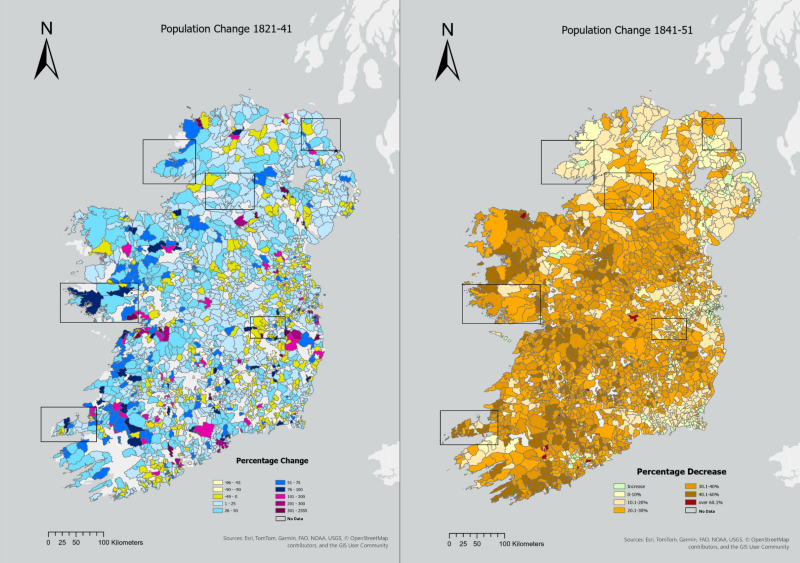
Landscapes of Catastrophe harnesses the island of Ireland’s rich empirical historical and archaeological resources and deploys novel approaches to build a benchmark dataset for the broader contexts of the Great Irish Famine, focusing on developing an evidence base for detailed understandings of ecological, biological and landscape change. Despite the fact that the character of demography and landscape in rural Ireland is widely attributed to the catastrophic impact of the Famine, this remains to be tested at localised scales and contextualised more widely within longer-term trends vis-a-vis agricultural, environmental and economic change in eighteenth to twentieth-century Ireland. Our project takes six case studies which cross-cut different landscape, environment, economic and agricultural areas to address these major lacunae and build a new narrative and understanding of the Famine and its impact, grounded in intersectional accounts of human experience, resilience and adaptation.

Read more Read less

Impact of Research

The environmental and sociocultural origins and chronology of catastrophic events like the Great Irish Famine often remain poorly understood, and sometimes challenged by emerging multi-proxy data, due to methodological deficiencies and accepted narratives that are often structured by emotive and nationalistic accounts. This project aims to harness new advances to address these issues and unlock the entwined landscape and demographic dimensions of this catastrophe have long been central to anti-colonial and nationalistic narratives of identity and belonging. In turn, because regarded as relict and thus memorialized in the modern countryside, popular perceptions and present-day cultural management strategies curate such frameworks. Yet many accounts of aspects of heritage enmeshed in famine or catastrophic events globally, highlight a dearth of material remains framing commemorative strategies for human experience as key inhibitors for transnational heritages of famines. This project addresses these issues by (i) developing leading-edge methodological advancements, which (ii) facilitate novel and never-before-possible narratives of the material, social-ecological and biological contexts of Famine. 
 
While Landscapes of Catastrophe is a project grounded in the long-term setting and impact of the Great Irish Famine, the novel framework it develops can be used for characterizing broader social, cultural and environmental legacies of mass demographic catastrophes through an interdisciplinary lens. To do so it harnesses the transformative potential of novel methodologies at the interface of the humanities and sciences, using bio-geochemistry, palaeoecology, geoforensics and geochronology, alongside more traditional cultural approaches to landscape, material culture and paleoenvironmental reconstruction. This will resolve chronologies and trajectories for human-animal-environment relationships in the recent past, which are of major significance for addressing the social-ecological, biological and socio-economic impacts of catastrophic events globally. The ability of archaeological data to contribute to 18th–20th century analyses specifically, however, is often impeded by an inability to produce highly-constrained chronologies localising key environmental, biological and material changes. Our novel approach addresses this central global issue by deploying QUB’s state-of-the-art geochronology facility, to combine Pb-210, C-14 (radiocarbon) wiggle-matching and tephrochronology for integrated and holistic age-modelling. Moreover, the project capitalizes on an urgent and acute window for deploying Pb-210 to this end, resulting in a new method for studying environmental and material change in a global setting that can be transformational for several disciplines, and for the resonance of historic data with present-day discourses surrounding climate change, mitigation strategies, and human resilience.
 
Case studies consciously span different landscape, environmental, socio-religious and socio-economic areas, setting results in longer-term contexts to facilitate analysis of continuity/disjuncture, but also dynamic adjustments at local scales not yet accounted for in analyses of the Famine or its impacts. These include:

•    Western Connemara
•    North Antrim
•    Central Kildare
•    Central Fermanagh
•    Dingle Peninsula
•    West Donegal

These rich case studies alongside our novel approach allows us to test the role of resilience or anti-fragility frameworks proposed by recent analyses in empirically rich and highly constrained datasets. Our approach to building narratives of human-animal relationships in wider environmental contexts bottom-up from localised case studies can present powerful rejoinders to these analyses, creating space and data capable of intersectional narratives for formative but catastrophic events.
 

Major grants and funding

Arts and Humanities Research Council Standard Grant.

Publications

Aquino Lopez, M., Blaauw, M., Christen, J. et al. 2018. Bayesian Analysis of 210Pb Dating. Journal of Agricultural, Biological, and Environmental Statistics, 23 , 1-18. https://doi.org/10.1007/s13253-018-0328-7.

Plunkett, G. and Swindles, G.,_2022. Bucking the_ trend: population resilience in a marginal_  environment. Plos one 17(4) p.e0266680.

Gardiner, M., Plunkett, G. and Megarry, W. 2019. A Late Bronze Age field system and settlement on the Antrim Plateau: preliminary results. Journal of Irish Archaeology 28: pp.49-57.

Donnelly, C., Murphy, E., Allmond, G., Sloan, B. and Ruffell, A. 2021. On the Line: Archaeological investigation of a ‘famine road’ in Drummacoorin, Boho, Co. Fermanagh. Archaeology Ireland 35, 24-29.

Collaborators

The project is an entirely QUB-based but interdisciplinary collaboration led by:

Dr Patrick Gleeson, Queen’s University Belfast (Project Lead)
Prof. Gill Plunkett
Prof. Maarten Blaauw
Dr Will Megarry
Prof. Keith Lilley
Prof. Eileen Murphy
Dr Colm Donnelly

Sustainable Development Goals

SDG 3: Good Health and Well-Being
SDG 10: Reduced Inequalities
SDG 13: Climate Action
SDG 14: Life Below Water
SDG 15: Life on Land

Find out more

Contact Details / Social Media

p.gleeson@qub.ac.uk 
@papgleeson on X/Twitter

RELATED PROJECT

  • 14 CHRONO


Research Projects
  • Research Projects
QUB Logo
Contact Us

Archaeology, Geography and Palaeoecology

Elmwood Building
3A Elmwood Avenue
Belfast
BT9 3AZ
United Kingdom

Email: snbe@qub.ac.uk
Tel: +44 (0)28 9097 3350

GET DIRECTIONS

Architecture, Civil & Structural Engineering and Planning

David Keir Building, Stranmillis Road
Belfast
BT9 5AG
United Kingdom

Email: snbe@qub.ac.uk
Tel: +44 (0)28 9097 4006

GET DIRECTIONS

Quick Links

  • Home
  • Study
  • Careers
  • Research


© Queen's University Belfast 2024
  • Privacy and cookies
  • Website accessibility
  • Freedom of information
  • Modern slavery statement
  • Equality, Diversity and Inclusion
  • University Policies and Procedures
Information
  • Privacy and cookies
  • Website accessibility
  • Freedom of information
  • Modern slavery statement
  • Equality, Diversity and Inclusion
  • University Policies and Procedures

© Queen's University Belfast 2024

Manage cookies