
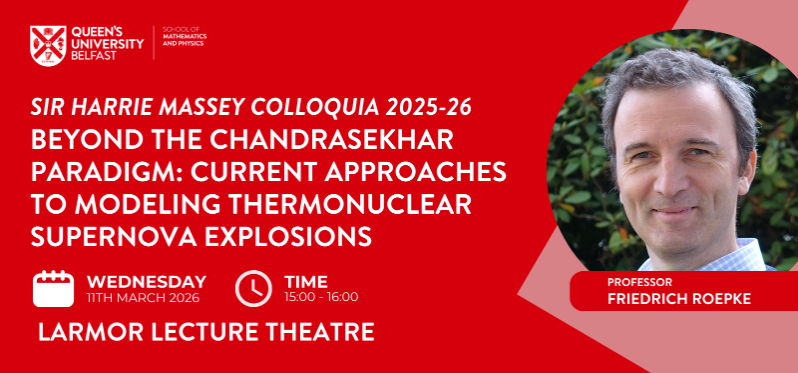
We are delighted to welcome Professor Friedrich Roepke to the school as part of our 2025-26 Sir Harrie Massey Colloquia Series.
- Date(s)
- March 11, 2026
- Location
- Larmor Lecture Theatre
- Time
- 15:00 - 16:00
- Price
- Free
Professor Friedrich Roepke will deliver a lecture titled 'Beyond the Chandrasekhar Paradigm: Current Approaches to Modeling Thermonuclear Supernova Explosions'
An abstract and biography can be found below.
Abstract:
The most prominent thermonuclear explosions in astrophysics are those involving white dwarf stars that give rise to Type Ia supernovae. These events have played a fundamental role in establishing our current cosmological model; however, the physical processes that drive them remain poorly understood. What are the stellar progenitor systems of Type Ia supernovae, and how do they initiate the explosions? How do these explosions unfold, and how are their physical parameters connected to observable properties? Addressing these questions is essential not only to reinforce the use of Type Ia supernovae as cosmological probes, but also to clarify their role in enriching the Universe with heavy elements. Beyond the standard “normal” Type Ia supernovae, several distinct classes of transient astronomical events have been identified that are likewise associated with thermonuclear explosions of white dwarf stars.
I will discuss how current observations constrain our models of thermonuclear supernovae and how these models are implemented in numerical simulations that enable us to test different theoretical scenarios. Such simulations have prompted a shift away from the traditional textbook picture of Type Ia supernovae originating from white dwarf stars nearing the Chandrasekhar mass limit, toward alternative progenitor evolution pathways and explosion mechanisms that are now the subject of active debate.
Biography:
Since 2015, I have been (Full) Professor of Theoretical Astrophysics at Heidelberg University and have lead the group “Physics of Stellar Objects” at the privately funded Heidelberg Institute for Theoretical Studies. At present I hold an ERC Advanced Grant on modeling common-envelope events in binary stellar evolution. Before moving to Heidelberg, I was (Associate) Professor of Astrophysics at the University of Würzburg, after leading an Emmy Noether Junior Research Group at the Max Planck Institute for Astrophysics, Garching, Germany.
My research focuses on theoretical stellar astrophysics and involves three-dimensional (magneto-)hydrodynamic simulations of processes in stellar interiors, stellar binary systems and thermonuclear supernova explosions