
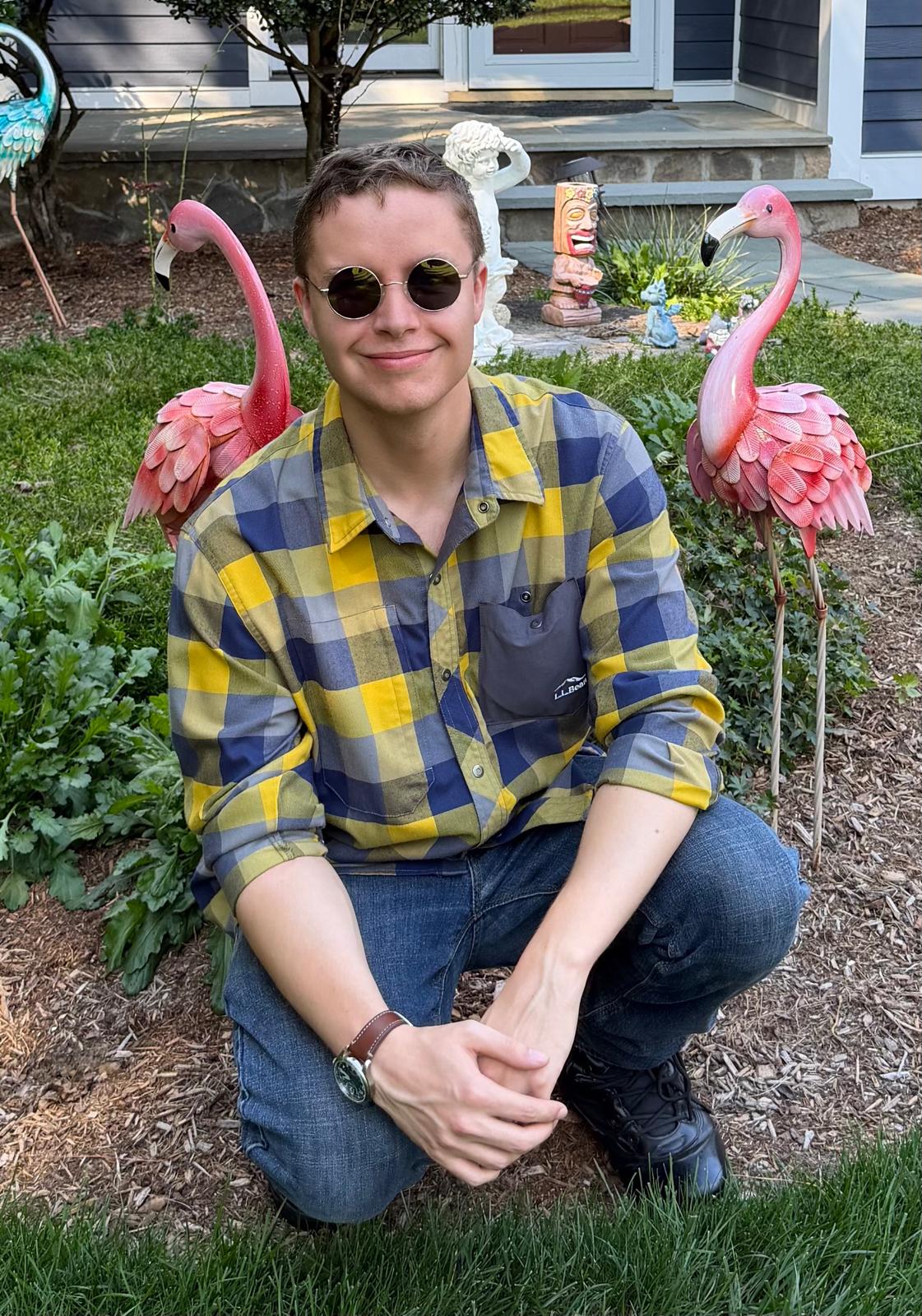
Thomas Mitchell - Student Profile
Current Research Project:
Searching for stellar activity cycles using multi-wavelength data
I work on stellar activity reduction methods using CCFs, GPs, decorrelation vectors and LSD methods, primarily through RV sun-as-a-star observations. Stellar variability is known to cause temporal distortions in the line profiles of stars. These distortions, if left unmitigated, corrupt radial velocity (RV) observations. Typically, cross correlation functions (CCFs) are used in tandem with various methods, such as decorrelation vectors and Gaussian processes to reduce variability-induced distortion in RVs. Least-Squares Deconvolution (LSD) is an alternative to the CCF method and can provide higher signal-to-noise ratios and better preserve subtle line-shape variations. Despite this, there has been little work utilising LSD line profile extractions with the stellar variability reduction methods commonly used with CCFs.
Biography:
Originally from the USA, I graduated Magna Cum Laude with a BA in Astronomy from Cornell University and minors in Science Communication and Physics. I went on to the UK to earn an MSc in Astrophysics with Merit from the University of St. Andrews. For my Masters thesis I utilised novel combinations of stellar activity reduction methods through both Gaussian Process and decorrelation vectors.
Research Interests:
Exoplanets, High Precision Radial Velocity, Data-Analysis, Stellar Activity, Stellar Science, Science Communication and Outreach
Supervisors:
Professor Gavin Ramsay & Professor Chris Watson