
Laboratory Efficiency Assessment Framework (LEAF)
Laboratory Efficiency Assessment Framework (LEAF)
The School of Biological Sciences is the proud recipient of LEAF accreditation in nine laboratories. Seven laboratories in Chlorine Gardens have achieved silver accreditation, while the Chlorine Gardens Teaching Lab and the Portaferry Marine Lab have both received gold accreditation for the 2024/2025 academic year. Further details below:
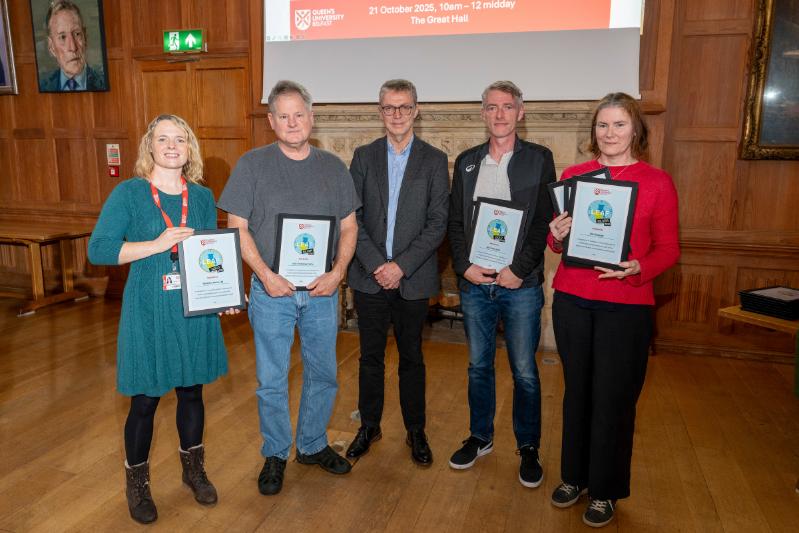
Gold Accreditation |
Silver Accreditation |
|---|---|
|
|
Learn More
-
LEAF: What Is It?
LEAF is a sustainable lab certification programme that was launched at Queen's University in September 2021 as a means of exploring methods to help labs across campus become more aware of their sustainability.
- LEAF Origins
Created by University College London (UCL), LEAF is a set of criteria that allows labs to determine if they are following sustainable practices in their teaching and research. This includes reducing waste, sharing materials with other labs, decreasing energy usage etc.
- How It Works
LEAF labs within Queen’s are provided a list of environmental activities on the LEAF platform that facilitate and drive improvements in laboratory efficiency. Each activity is a clear, easy to implement action. LEAF users complete these actions in order to improve their lab efficiency. Following a peer audit of each lab, the labs will then be awarded a rating of Bronze, Silver or Gold depending on the level of sustainability reached.
LEAF Criteria have been specifically selected to cover not just environmental aspects (e.g. waste management, procurement, equipment efficiency, chemical management etc.) but also to target business travel and research quality, addressing the international issues surrounding the 'reproducibility crisis'. LEAF uses a set of calculators to enable users to quantify 'actual' environmental and financial savings.
- Benefits Of Gaining A Green Lab Certification
There are numerous benefits from labs being involved in the LEAF Programme. These include:
-
- Reduced utility costs and environmental footprint
- Ensuring health and safety compliance within labs
- Increased research efficiency
- Provides recognition for individuals labs and the University on a national stage
- Enables a bottom-up sustainability movement
- Helps integrate different labs and departments from around the University
- Practice-based learning experiences that improve professional skills and employability
- Strengthening of relationships between Estates, lab users and other stakeholders
- The chance to align your research with the University Net Zero Strategy
- Inter-lab and inter-departmental benchmarking
- Creating a better understanding within our community of our science buildings and operations
- Labs being able to align with our commitment to the Sustainable Development Goals
-