
Top Skip to main content
Skip to Content
LOGO(small) - Queen's University Belfast
  • Our facebook
  • Our linkedin
  • Our instagram
LOGO(large) - Queen's University Belfast

School of

Biological Sciences

  • Home
  • Study
    • Undergraduate Courses
    • Postgraduate Taught Courses
    • Fieldwork Opportunities
    • Peer Mentor Scheme
    • Scholarships and Awards
    • Course Accreditations
  • Research
    • Research Themes
    • Research Impact
    • Research Culture
    • Recent Research Outputs
    • Postgraduate Research
    • PhD Opportunities
    • Find a PhD Supervisor
    • Centre of Excellence for Agri-Food Microbiomes (CEAM)
  • International
    • Partnerships
    • Students
    • Opportunities
    • Take a Virtual Tour of Queen's
  • Employability
    • Business Engagement
    • Employer Testimonials
    • Undergraduate Careers & Placements by Sector
    • Postgraduate Careers & Placements by Sector
    • Student Experiences
    • Alumni Profiles
    • News, Programmes and Events
  • About
    • Facilities
    • Gibson Institute
    • Athena Swan
    • Laboratory Efficiency Assessment Framework (LEAF)
    • Applying for Honorary and Visiting Titles
    • Nursing Mothers and Parents’ Room & Quiet Room
  • People
    • Key Contacts
    • School Management Committee
    • Academic Staff
    • Professional Services Staff
    • Technical Staff
    • Research Staff
    • Honorary Staff
  • Staff Profiles
    • Dr Connor Bamford
    • Dr Simon Cameron
    • Prof Lisa Connolly
    • Mr Ronan Cunning
    • Dr Lucia Lombardi
    • Prof Aaron Maule
    • Ms Alison Meredith
    • Dr Linda Oyama
    • Prof Paulo Prodöhl
    • Dr Rachel Wheatley
  • News
  • Graduation
    • 2025
  • Events
  • Home
  • Study
    • Undergraduate Courses
    • Postgraduate Taught Courses
    • Fieldwork Opportunities
    • Peer Mentor Scheme
    • Scholarships and Awards
    • Course Accreditations
  • Research
    • Research Themes
    • Research Impact
    • Research Culture
    • Recent Research Outputs
    • Postgraduate Research
    • PhD Opportunities
    • Find a PhD Supervisor
    • Centre of Excellence for Agri-Food Microbiomes (CEAM)
  • International
    • Partnerships
    • Students
    • Opportunities
    • Take a Virtual Tour of Queen's
  • Employability
    • Business Engagement
    • Employer Testimonials
    • Undergraduate Careers & Placements by Sector
    • Postgraduate Careers & Placements by Sector
    • Student Experiences
    • Alumni Profiles
    • News, Programmes and Events
  • About
    • Facilities
    • Gibson Institute
    • Athena Swan
    • Laboratory Efficiency Assessment Framework (LEAF)
    • Applying for Honorary and Visiting Titles
    • Nursing Mothers and Parents’ Room & Quiet Room
  • People
    • Key Contacts
    • School Management Committee
    • Academic Staff
    • Professional Services Staff
    • Technical Staff
    • Research Staff
    • Honorary Staff
  • Staff Profiles
    • Dr Connor Bamford
    • Dr Simon Cameron
    • Prof Lisa Connolly
    • Mr Ronan Cunning
    • Dr Lucia Lombardi
    • Prof Aaron Maule
    • Ms Alison Meredith
    • Dr Linda Oyama
    • Prof Paulo Prodöhl
    • Dr Rachel Wheatley
  • News
  • Graduation
    • 2025
  • Events
  • Our facebook
  • Our linkedin
  • Our instagram
In This Section

  • Home
  • School of Biological Sciences
  • News
  • Archive

Archive

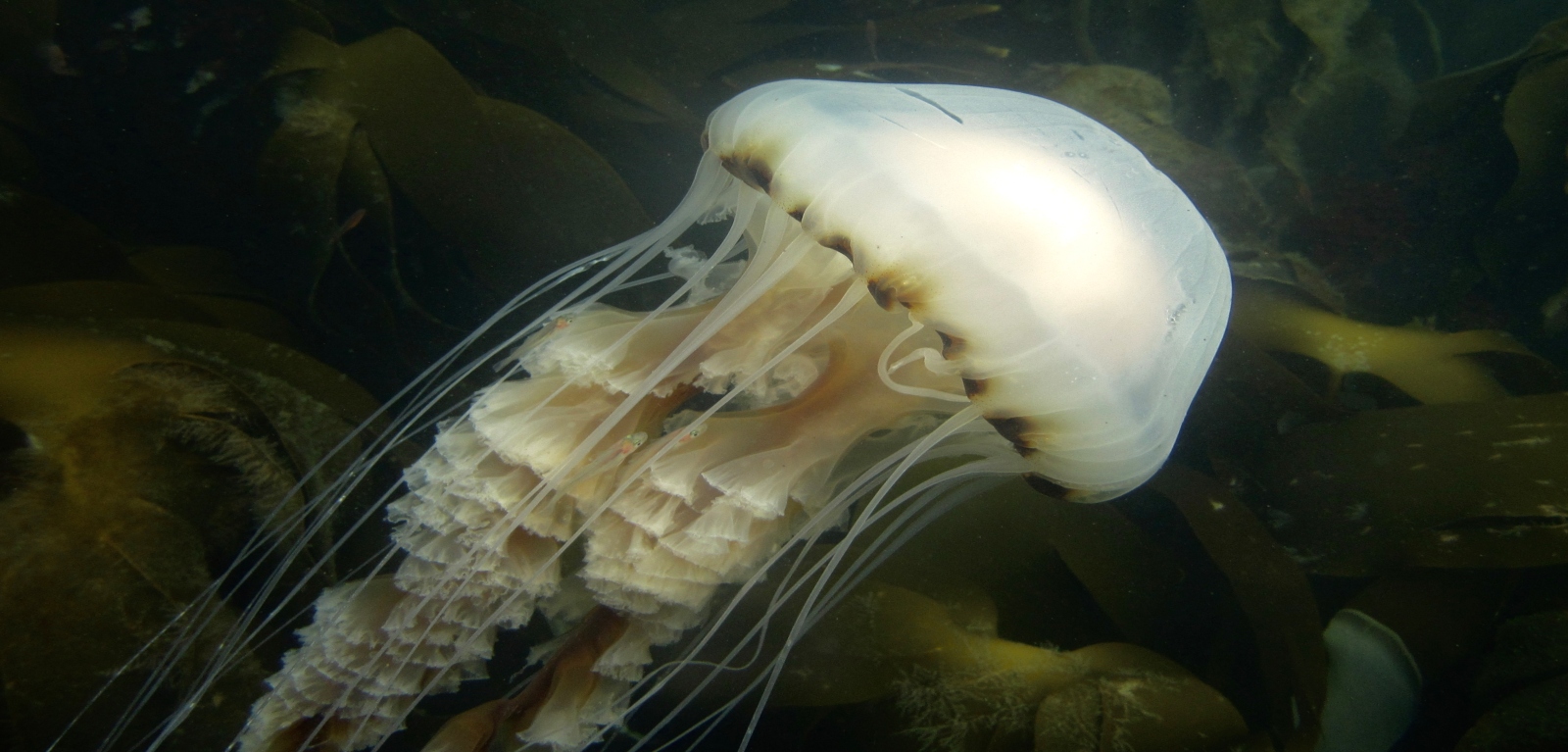
Life in the gingerbread house: how fish need jellies more than we thought
21 March, 2019

Researchers at Queen’s University Belfast have coined jellyfish, ‘the gingerbread house’, conveying their newly discovered role in providing both food and shelter to fish.

Researchers at Queen’s University Belfast have coined jellyfish, ‘the gingerbread house’, conveying their newly discovered role in providing both food and shelter to fish.

Jellyfish have long been described as ‘arguably the most important predators in the seas’, competing with adult fish for food, or by preying on eggs and larvae to reduce survivorship and recruitment of fish stocks.  Certainly such mechanisms are at play, but a recent study led by Queen’s and published today (20 March) in Proceedings of the Royal Society B journal suggests they might be counterbalanced by other traits rendering jellyfish much more beneficial to marine life than previously thought.

Building on the fable of the ‘gingerbread house’, the research team of international scientists have shown that a vast array of fish species associates closely with jellyfish to obtain both shelter and sustenance when they are young.

Dr Jonathan Houghton, Senior Lecturer from the School of Biological Sciences at Queen’s University Belfast, said: “Upon discovering that jellyfish are an important food sustenance as well as providing shelter, we thought it apt to compare them to ‘the gingerbread house’, depicting their dual benefit as a house you can eat.”

The research also found that over two thirds of the fish species found to ‘partner up’ with jellyfish were of commercial value, and often recovering from long term-stock depletion. This has huge implications, not only for the food chain but also for the global fishing industry, which has an estimated value of USD 362 billion.

Lead author Mr Donal Griffin, Researcher from the School of Biological Sciences at Queen’s University commented: “The sheer number of fish-jellyfish associations documented all across the globe may surprise some, but considering young, juvenile, otherwise vulnerable fish are getting shelter and food from the interaction for free, maybe we should be surprised there aren’t more examples out there.”

Co-author Dr Isabella Capellini, Senior Lecturer in Vertebrate Zoology at the University of Hull said: “Most surprisingly, we found that association with jellyfish may have pre-empted a habitat shift in some species with fish moving over evolutionary time from open water habitats to life at the seabed, or even coral reefs." Given that fish and jellyfish have co-existed for a very long time (~550 million years) there are likely other twists in the tale yet to come, but for now the notion of millions of fish sheltering in their floating homes provides significant food for thought.

Dr Houghton added: “The significance of the associations between fish and jellyfish really cannot be underestimated. Our findings indicate that a huge range of fish rely on jellyfish to survive, whether this is to protect themselves from predators, to gain sustenance, or both.

“Our perception of jellyfish has switched hugely, thanks to recent research.  It’s almost a reboot of jellyfish ecology as a central part of the ocean system. There is now a pressing need for further research to better understand the relationship and inter-dependencies between jellyfish and fish. That way we can see their value as well as their limitations.”


Photo credit: Karen Patterson

Dr Jonathan Houghton
View Profile
Share
Latest News
  • Remembering Professor Simon Doherty - our colleague, friend and mentor
    18 December, 2024
  • £14 Million in Funding Announced for Five Research Projects into Land Use and Net Zero
    29 November, 2024
  • Queen's-led project to drive better health outcomes and local economy with AI
    21 November, 2024
  • SBS Professor Awarded World’s Most Prestigious Food Science Prize
    20 November, 2024
  • Global Issues Poster Symposium 2024
    20 November, 2024
QUB Logo
Contact Us

School of Biological Sciences

Queen's University Belfast
School of Biological Sciences
19 Chlorine Gardens
Belfast BT9 5DL
Northern Ireland

GET DIRECTIONS

  • Phone: +44 (0)28 9097 5787
  • Email: sbsigfsoffice@qub.ac.uk 

Quick Links

  • Home
  • Study
  • Research
  • People
© Queen's University Belfast 2026
Privacy and cookies
Website accessibility
Freedom of information
Modern slavery statement
Equality, Diversity and Inclusion
University Policies and Procedures
Manage cookies