
ELASMO
Electrosensory Lab for Adaptive Species Management in the Ocean - ELASMO
Bycatch of sharks, skates and rays remains one of the most pressing threats to marine biodiversity, with species such as the flapper skate (Dipturus intermedius) classified as Critically Endangered. Current management measures, including gear modifications and time–area closures, often fail to provide effective, scalable solutions that protect vulnerable elasmobranchs while maintaining viable fisheries. This project establishes new electrophysiology and behavioural testing facilities at Queen’s University Marine Laboratory to pioneer an alternative approach: harnessing elasmobranchs’ sensitivity to electromagnetic fields (EMFs).
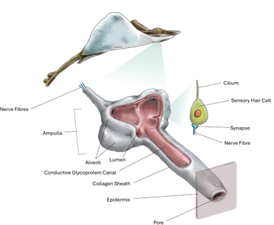
Figure: The electrosensory organ of elasmobranchs; the Ampullae of Lorenzini
Through controlled mesocosm and respirometry experiments, we are quantifying species-specific electrosensory thresholds and behavioural responses to EMF exposure. These data are being used to calibrate prototype deterrent devices for integration with commercial fishing gear. Subsequent field validation, including paired trawl trials and live video monitoring in known skate habitats, will assess the ecological effectiveness and operational feasibility of the technology.
Our approach is co-developed with fishers, managers and policymakers, ensuring that solutions are both practical and policy-relevant. By reducing incidental capture of elasmobranchs, the project directly supports international biodiversity targets (CBD 30x30, OSPAR 2030) and the Northern Ireland Elasmobranch Conservation Strategy. Beyond immediate conservation benefits, ELASMO builds long-term research capacity in sensory ecology and fisheries management, positioning Northern Ireland as a hub for innovation in sustainable marine technologies.
Project staff: Dr Patrick Collins (PI), Dr Samuel Smith (PDRA), Dr Fergal Glynn (PDRA)
Funder: DAERA