Gibson Institute
Gibson Institute for Land, Food and the Environment
The Gibson Institute for Land, Food and the Environment sits within the School of Biological Sciences at Queen's University Belfast. It is part funded by The Gibson Trust.
William Gibson was born in 1838, the son of a small farmer in Co. Down, Northern Ireland. Gibson began his career as an apprentice watchmaker before starting his own business. This expanded, and Gibson became a highly respected Jeweller. In 1909, William Gibson presented Queen’s University with a gold mace to commemorate its new status as a University.
The role of the University Mace
The bearer of the mace in academic processions guards the Chancellor in the tradition in which medieval sergeants-at-arms marched as royal bodyguards. The Esquire Bedell bears the mace in the Queen’s University Belfast academic procession. They lead the Chancellor or Vice-Chancellor into the ceremony and put the mace on stand on the stage, which is the cue for members of the academic procession to remove their head dress. The Esquire Bedell also looks after the honorary graduates, leading them out at the end of the ceremony. The mace is always present during the conferment of degrees.
-
William Gibson died, aged 74, on the 1st November 1913, leaving an estate of £305,601 (worth almost £25 million today). After several bequests, including £10,000 (worth nearly £1 million today) to Queen’s University Belfast for the establishment of special agricultural scholarships, he directed that the residue of his estate should be used “for the purpose of assisting poor and deserving farmers and holding farms in County Down and County Antrim, Ireland”. From this, the Gibson Trust was founded.
The Gibson Trust currently has three trustees – William Montgomery, Edward Montgomery, and John Witchell.
The Agri-Food and Biosciences Institute (AFBI) founded the Centre for Rural Studies, in 1996, to teach people to work with available European Union Leader II funding for Rural Projects.
From this, the Gibson Institute for Land, Food and the Environment was launched in 1999.
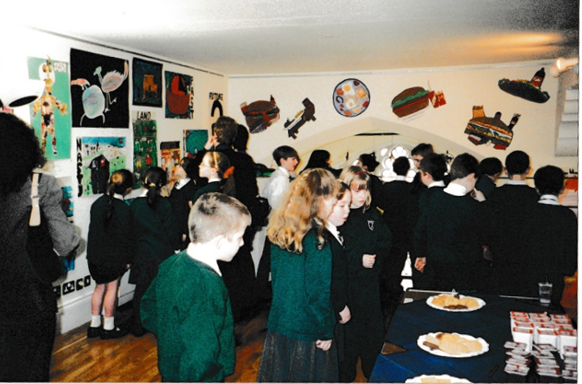
The launch event was held in Queen’s University’s Canada Room and included a talk from renowned artist T.P. Flanagan and a display from the Ulster Folk and Transport Museum.
As part of the launch, local school children were also invited to produce artwork, related to rural studies and the environment, which was displayed in Queen’s University Visitor's Centre.
Since its launch, the Gibson Institute has produced 44 undergraduates and 606 postgraduates with degrees in the fields of land, food, and the environment.
Thanks to the generous support of the Gibson Trust, a number of bursaries are available to support Northern Ireland-domiciled students enrolling to the MSc Leadership for Sustainable Development and MSc Leadership for Sustainable Rural Development programmes. The bursaries are intended to support access to postgraduate study for individuals committed to developing the leadership skills needed to drive sustainability transitions across sectors.
Undergraduate:
- BSc Agricultural Sciences
- BSc Agricultural Sciences with Professional Studies
- BSc Environmental Management
- BSc Environmental Management with Professional Studies
Postgraduate:
Gibson Institute Bursaries
Every year the Gibson Trust offers several studentships for local students studying the MSc Leadership for Sustainable Development or MSc Leadership for Sustainable Rural Development programme. The studentships cover the course fees. For enquiries, please visit the Funding & Scholarship page or contact Dr Adewale Adenuga.
Researchers in the Gibson Institute are advancing a joined-up programme of work focused on farming, land use and the wider agri-food system—consistent with the Institute’s mission to support the sustainability of agriculture in Northern Ireland, particularly the small farming sector, and to contribute to improved rural life and civic society.
Prof. Alberto Longo strengthens the Institute’s farming and land-use portfolio through applied agri-food and environmental economics, with a particular focus on robust evaluation (e.g., cost–benefit analysis and non-market valuation) and behavioural insights. Current work includes research on (a) farmers’ willingness to adopt innovations that help agriculture adapt to and mitigate climate change (Horizon Europe Re-Livestock); (b) Social Farming for Peace and Inclusion (Peaceplus SoPi project); (c) social prescribing to help reducing greenhouse gas emissions in the health and social care pathways (UKRI Sustainable Health System Hub); (d) the role of green areas to improve people’s wellbeing (UKPRP Groundswell); (d) behavioural methods to address antimicrobial resistance (UKRI FAN). Past work has used micro-econometric methods with applications to energy, health, environment, cultural heritage, food, risk, physical activity. In his research, he has advised the World Bank, UNEP, RSPB, the Utility Regulator NI among others.
Prof. George Hutchinson provides strategic leadership in rural and environmental economics, with research spanning agri-food, biodiversity, water resources and climate action. His work connects farm-level and land-use decisions to broader risks and opportunities across the food chain, including through contributions to major climate risk and sustainability assessments. Current projects explore the role of financial investments to protect biodiversity, (FRIBO, BIOFIN), healthy and sustainable food (Sus-Health. Sustainable and Healthy diets for all). Previously he led research at QUB on the value of agri-environment schemes, the value of forestry, and on risk, food choices and physical activity.
Dr Henry Adewale Adenuga focuses directly on how policies and farm decisions can deliver sustainable land use and resilient rural systems. His research evaluates agri-environment and rural programmes, farm performance, and the economics of animal health and welfare—placing particular emphasis on farmer behaviour, incentives, training, and the practical needs of policymakers and advisors. Adewale is also the director of the MSc Leadership for Sustainable (Rural) Development.
Dr Eileen Mitchell applies behavioural economics and AI to key agri-food challenges, including research on the risk factors shaping farmers’ uptake of sustainable practices and the economic and social impacts of animal disease—linking farm outcomes to public health and sustainability goals.
Dr Amanda Slevin contributes complementary expertise on climate policy, inequalities, just transition and participatory decision-making—capabilities that help ensure that pathways to more sustainable farming and land management are socially workable, policy-relevant and grounded in stakeholder engagement. Current projects include the Co-Centre for Climate + Biodiversity and Water.

Please get in touch to learn more about our work and institute:
- Director of the Gibson Institute | Professor Alberto Longo
- Emeritus Director | Emeritus Professor George Hutchinson
- Deputy Director | Dr Adewale Adenuga
- Lecturer | Dr Eileen Mitchell
- Lecturer | Dr Amanda Slevin
- Lecturer (Education) | Dr Natasha McGowan
- Honorary Senior Lecturer | Dr Jude Stephens
- Placement and Careers Officer | Ms Grace Heatley