
Talented graduate earns PhD after developing breakthrough new way to protect farmers and wildlife
Dr Ryan Magee graduates today with a PhD in Biological Sciences, having developed a faster, cheaper method to track a major livestock disease.
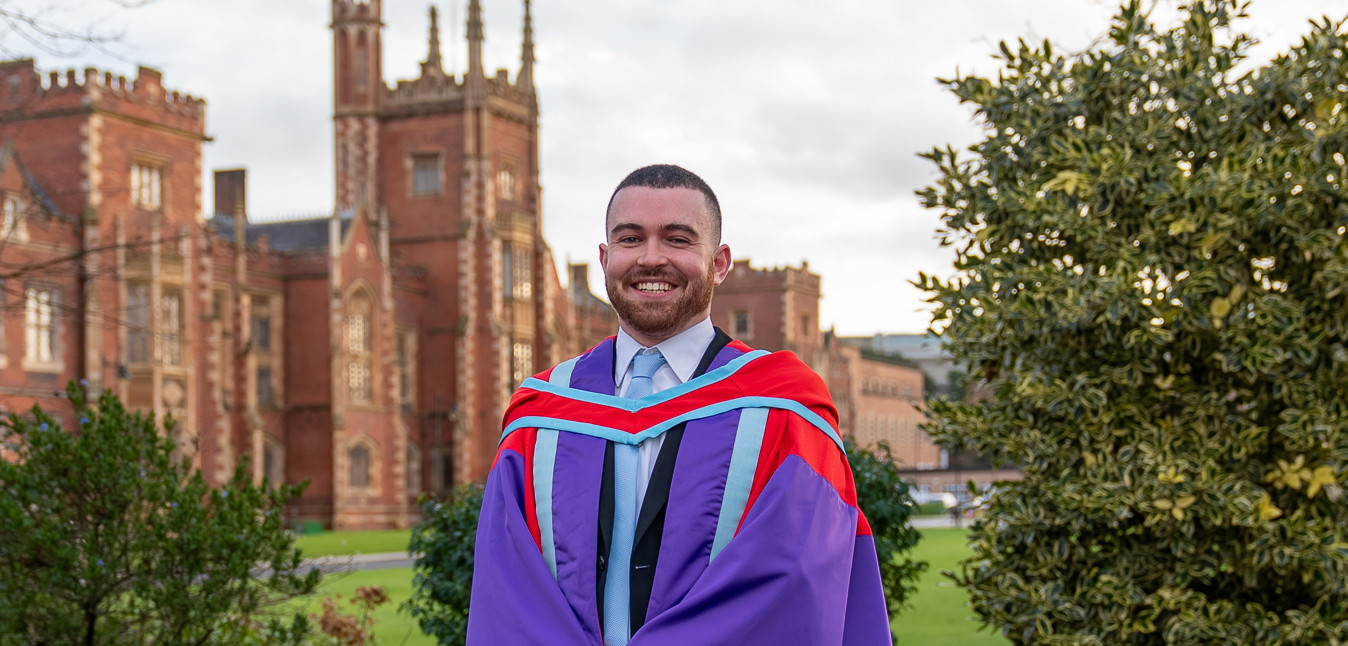
Dr Ryan Magee, from Derry, is graduating today from Queen’s University Belfast with a PhD, after developing a simple, rapid and low-cost way to identify different strains of bovine tuberculosis – a disease that continues to place huge pressure on farmers and rural communities across Ireland.
Bovine TB remains one of the most persistent and costly animal health challenges across the island, affecting farmers, wildlife and government agencies on both sides of the border. For Ryan, what began as an interest in population genetics during his undergraduate degree at Queen’s, quickly turned into a passion for tackling a disease with real-world impact – one that carries significant financial and emotional strain for farming families.
As he explains:
“I didn’t know much about bovine TB beyond that it infected cattle and badgers before beginning my research. I had read the work of my to-be supervisors, Robin Skuce and Adrian Allen at the Agri-Food and Biosciences Institute, going into the BTBGenIE (Bovine Tuberculosis Genomics Ireland) project and was really interested. It’s the UK and Ireland’s costliest, most controversial and most complex pathogen capable of passing between animals and humans, and I became increasingly invested in the disease itself as I learned more about its scale, impact and complexity.”
Ryan joined the project with strong training in molecular genetics and bioinformatics, skills he credits to his placement year in Queen’s Fish Genetics Research Group under Professor Paulo Prodӧhl. He learned a lot from Paulo and those who trained him in the lab – namely Rosaleen, Caroline and Cliodhna.
Ryan said:
“I learned a lot from them, including the odd bit of science. They have been behind every step I’ve taken since 2018, and I certainly wouldn’t be where I am today without them.”
During his PhD, Ryan helped analyse more than 1,000 whole-genome sequences of the bacterium, creating the most detailed genetic family tree of the pathogen in Ireland to date. From this, the team identified the smallest number of genetic markers needed to reliably distinguish one variant from another. The result is a simple DNA test that can identify a bovine TB strain within hours using equipment already available at Queen’s.
Ryan describes its value in everyday terms:
“Instead of reading all 4.3 million positions of the bacterium genome, our test reads just 28 of the most informative ones. It’s not a replacement for whole-genome sequencing, but it’s a really useful triage tool. It lets labs screen huge numbers of samples quickly and cheaply, which means clusters of infection can be spotted earlier and sequencing can be used where it’s most informative.”
His research also explored how bovine TB moves around the island, focusing on a key stretch of the border between Monaghan and the surrounding Northern counties. Contrary to expectations, the team found that most transmission happens locally within each jurisdiction, with relatively little cross-border spread.
Ryan’s presentation of this work earned an international award at the European Society of Mycobacteriology conference in Bruges.
He recalls what this moment felt like, with humour:
“I was glad to see it. The project was a team effort built on decades of local research efforts, designed by my supervisory team and I was the one fortunate enough to be presenting it, and lucky enough to do so in Bruges. Although, if any future employers are reading this, I did the whole thing myself. If anything, my team held me back!”
Throughout his PhD, the support from Queen’s and the Agri-Food and Biosciences Institute (AFBI) shaped both Ryan’s skillset and his confidence.
He reflects:
“I was surrounded by people who cared about my development. My supervisors at Queen’s were incredibly engaged, and my external supervisors at AFBI taught me how to think about the real-world impact of the work.”
That support has helped Ryan move directly into his dream role. In January, he will join the UK Animal and Plant Health Agency as a Microbial Genomics Scientist, continuing the very work he trained for at Queen’s.
Looking back, he says his biggest takeaway is simple:
“Bovine TB isn’t one big outbreak, it’s lots of small local micro-epidemics. Continuing to apply new science and methods and focusing on the regionalisation of control can make the system more effective and less disruptive for farmers and wildlife. My PhD has added evidence for that, and a new tool to help deliver it.”
Ryan now leaves Queen’s with a breakthrough contribution to one of Ireland’s most persistent animal health challenges and with deep appreciation for the training, mentorship and opportunities that helped him get there.
Media
Media enquiries to Queen’s Communications Office on email: comms.office@qub.ac.uk