Driven graduate tops class while navigating severe chronic illness
Caitlin Mannis graduates today with a Master’s in Global Security and Borders, achieving this milestone through determination while navigating significant challenges posed by severe chronic illness.
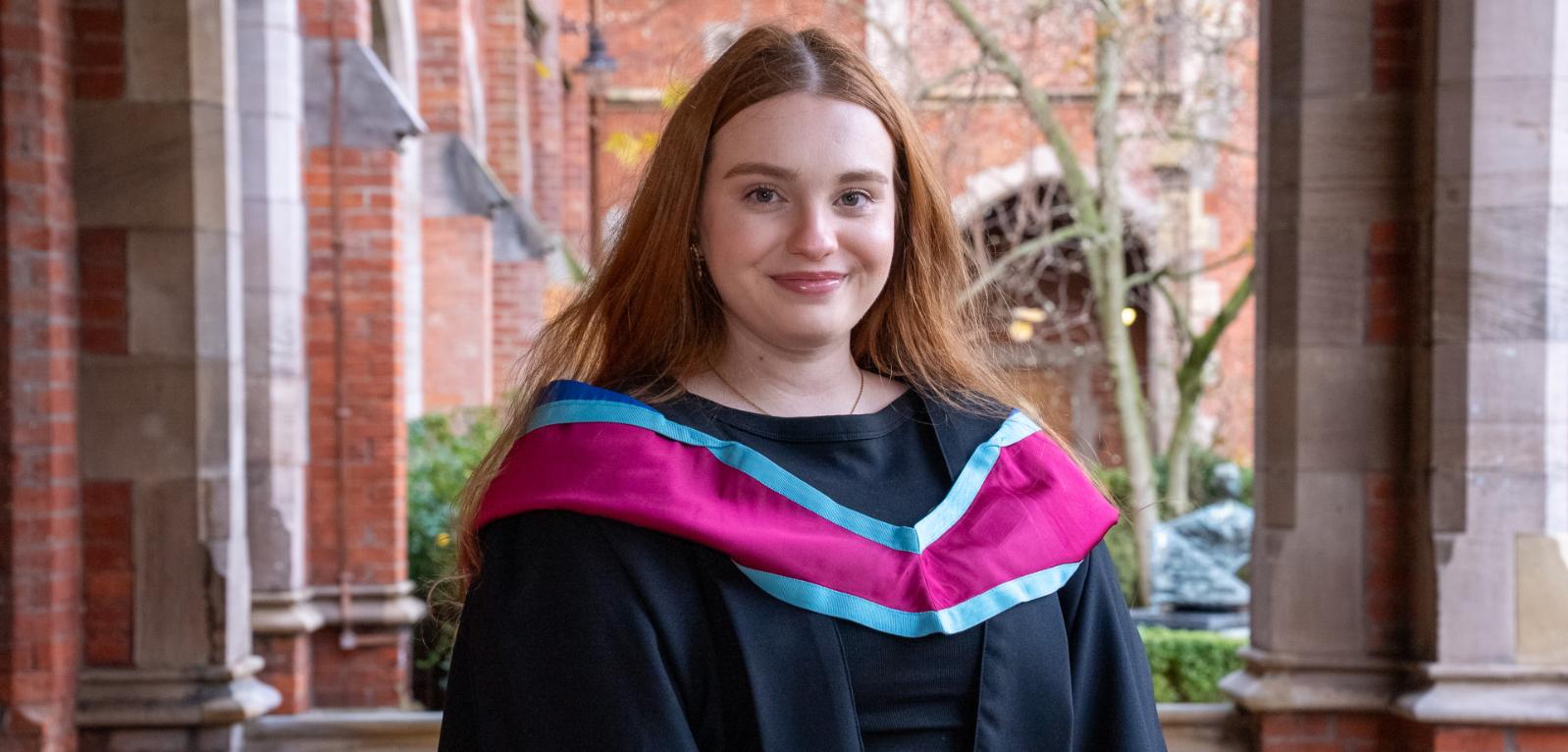
Caitlin Mannis from Ballygowan, Co. Down, is graduating today from Queen’s University Belfast with a Master’s degree in Global Security and Borders.
Living with Ehlers-Danlos Syndrome (EDS), a genetic condition that weakens the connective tissue that affects skin, joints and blood vessel walls, Caitlin has faced challenges that are often invisible to others.
She said:
“From the outside, I often look completely fine. No one else sees the joint instability, the pain, or the unpredictability, unless I bring it up, and that invisibility creates its own challenges.”
Despite living with a life-long health condition, as well as ADHD and suffering from chronic migraines, Caitlin achieved outstanding academic success, graduating with the highest grade in her cohort.
Throughout her studies, support came not just from individuals but from the entire learning environment that valued unconventional thinking. Her supervisors encouraged original research, allowing Caitlin to explore ideas beyond traditional security studies and grow academically while accommodating her needs.
Managing her condition required creative adaptations, from working in bed with a rolling desk, to using voice recordings when typing became too painful.
Caitlin explains:
"I adapted my study routines by being honest about what my body could manage and adjusting the method rather than the goal. I wear splints to support my joints. I’ve had the ones I wear on my finger’s gold plated to look more like jewellery, something that makes me feel more confident but comfortable because they hold my joints in place. They make typing, which at the moment does take up much of my day-to-day life, that little bit easier.”
Looking back on her journey at Queen’s, Caitlin offers a message of resilience and determination. When underestimated as a teenager, she turned doubt into motivation, a mindset that has guided her through her education.
She reflected:
“I was motivated by the determination that comes from being underestimated, and over time, learning that I have nothing to prove to anyone but myself, my condition does not define the limits of my ambition or my work. My message to anyone living with a long-term health condition is to live in spite, meaning decide you’re not going to shrink yourself to match the limitations someone else imagined for you.”
Since finishing her Master’s degree, Caitlin has gone on to begin her PhD at Queen’s, carrying on from her Master’s research exploring how gamified AI and personalised content can influence the radicalisation of women and girls.
She plans to celebrate her graduation day with her family, friends, and classmates from her course.
Media
Media enquiries to Queen’s Communications Office on email: comms.office@qub.ac.uk