Island of Ireland punches above its weight in cancer research and innovation worldwide, study finds
A collaborative approach to cancer research and innovation has placed the island of Ireland above many of its European counterparts in the scientific impact of its cancer research, a new study shows.
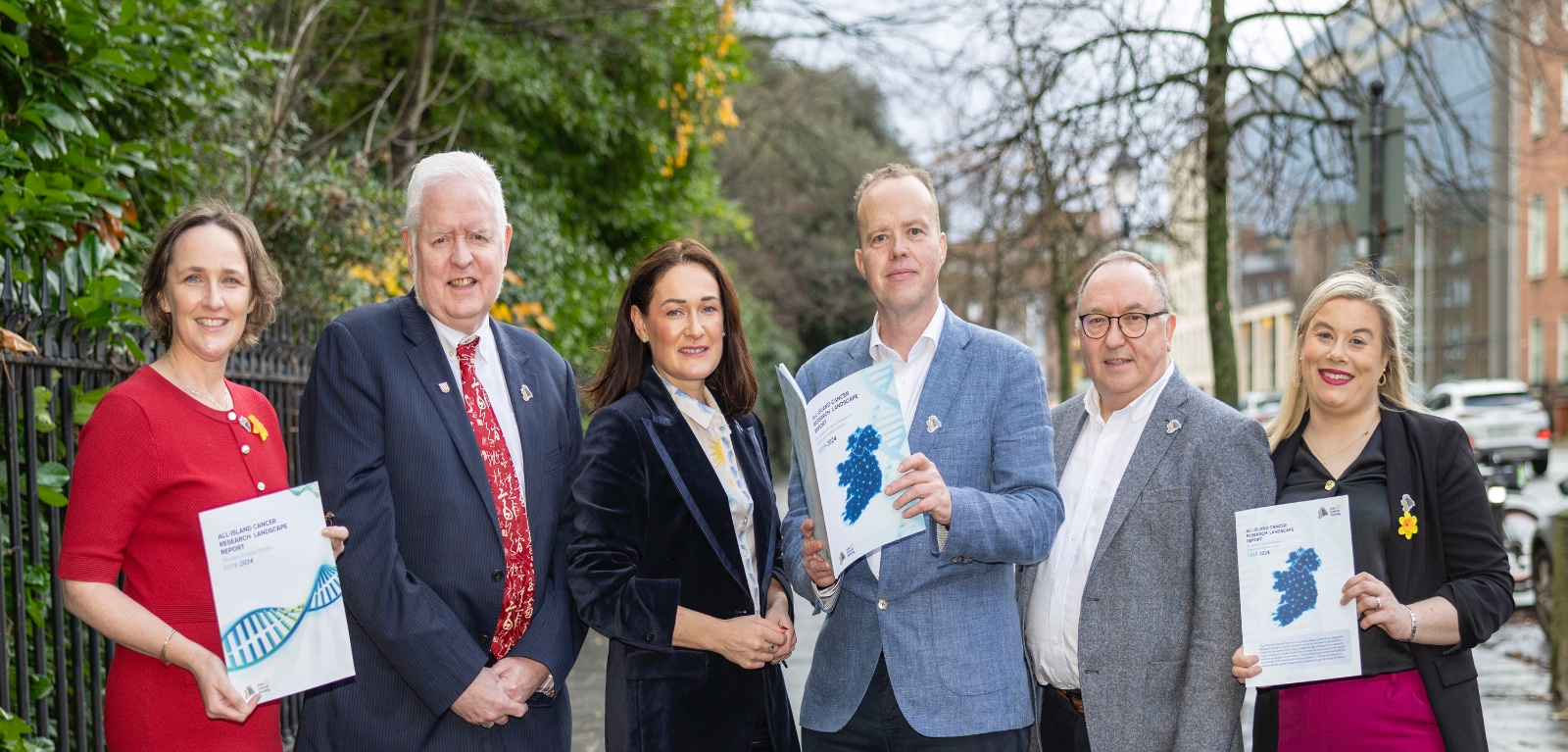
‘The All-Island Cancer Research Landscape Report: An Analysis of Cancer Research in Ireland and Northern Ireland 2019-2024,’ supported by the Irish Cancer Society, was launched today with the help of Erin McGreehan TD, Chair of the Oireachtas Committee on Further and Higher Education, Research, Innovation and Science, at an event in the Museum of Literature of Ireland, in Dublin.
The report, which was produced by the All-Island Cancer Research Institute (AICRI), examined the impact of cancer research from Ireland and Northern Ireland from 2019 to 2024 – measured by how often cancer research papers were cited (used) by the global scientific community.
The strongest indicator reported is that collaboration, especially international collaboration, consistently amplifies cancer research impact, achieving around 160% higher impact score* than the world average. Over 65% of cancer research papers in Ireland and Northern Ireland are co-authored with international partners.
While cancer research papers from Ireland and Northern Ireland achieved impact scores that were 110% and 90% higher than the world average, respectively, the impact was 130% higher for publications from joint cancer research activities.
Professor Mark Lawler, Professor of Digital Health at Queen’s University Belfast, co-lead of AICRI and co-author of the report said:
“Our data show what I’ve been saying for years: one, cancer knows no borders; and two, we need to compete, not against each other, but against our common enemy – cancer. Governments in Dublin and Belfast need to heed what our data reveal and what our report is telling them – together, we are better. This report quantifies just how much better we are.”
Professor William Gallagher, Professor of Cancer Biology at UCD, co-lead of AICRI and co-author of the report said: “This report highlights clearly that collaboration is the main driver for better, more impactful cancer research. Our data, covering over 10,000 cancer research publications across the island of Ireland over a recent 6-year period, shows that cross-border, international and academic-industry collaboration are key to ensuring high-quality. Approximately two thirds of our cancer research publications involve international collaborators, representing well over 100 countries worldwide.”
The impact of academic-industry partnerships was even greater, although they account for only 7% of output. Cancer research papers that involved an industry partner in Ireland and Northern Ireland had the strongest impact of all the partnerships evaluated, measuring at 700% and 250% higher than the world average, respectively.
Looking specifically at cancer clinical trials, the data reveal that academic-industry collaborations delivered research outputs that achieved at least 10 times greater impact than the world average, for both Ireland and Northern Ireland.
Professor Gallagher added: “Our work highlights areas of cancer research where we are particularly strong but also areas where we need to expand, including the critical areas of quality of life and palliative care. We need to see increased ambition for cross-border research between now and 2030, an expansion of clinical cancer trials across the island, and a deepening of collaboration between industry and academia in cancer innovation.”
Professor Mark Lawler added: “Our number one recommendation is to create an All-Island Cancer Research Co-Centre, bringing together researchers, healthcare professionals, patients and industry across the island. This could not be more timely or relevant, with the Irish National Cancer Control Programme commissioning a National Cancer Research Plan for Ireland, while [Northern Ireland] Minister Mike Nesbitt recently launched a Cancer Research Framework for Northern Ireland.
“We need to be braver and more ambitious than that and deliver a joint North-South initiative to beat a disease that kills a brother, a mother, or a partner and affects, in some way, every single person on this island. We may be small but we can do big things.”
Head of Research at the Irish Cancer Society, Dr Claire Kilty said: “The Irish Cancer Society is delighted to have provided funding for this timely report which showcases how well the island of Ireland is punching above our weight when it comes to excellence and quality in cancer research. This calibre of world-class cancer research expertise offers enormous hope that one day a future where no one dies of cancer in Ireland will be within our grasp.
“The results also highlight the enormous potential for us to intensify and deepen research collaboration, in particular on cancer trials, patient-facing research and by working closer with industry. As the largest voluntary funder of cancer research in Ireland, the Irish Cancer Society is committed to continuing to invest in these key areas to improve outcomes, care and quality of life of people affected by cancer across the island.”
Aidan McCormick, Cancer Patient Advocate and chair of the Northern Ireland Cancer Research Consumer Forum, said: “This is a wonderful learning opportunity for cancer patients, like myself. We can speak as patients and carers, however, we can also speak as potential cancer research partners with lived cancer experiences and that makes us unique and important. North-South collaboration enhances such opportunities.
"Rather than being passive recipients of healthcare, we believe that clinical research and cancer trials are enhanced by patients and carers working with clinicians, researchers, healthcare professionalsand colleagues. That high level of involvement empowers us and encourages us. It builds our confidence and understanding and gives us hope in the most challenging of times.”
Featured Expert
Media
Media inquiries to Sian Devlin at s.devlin@qub.ac.uk