KTP Careers: Shay McEvoy on Moving from KTP Associate to Senior Management
We caught up with Shay for a Q&A on his journey from Queen's Business Management graduate to KTP Associate, being named Innovate UK 'Future Leader', and moving into his new role as Business Development Manager.
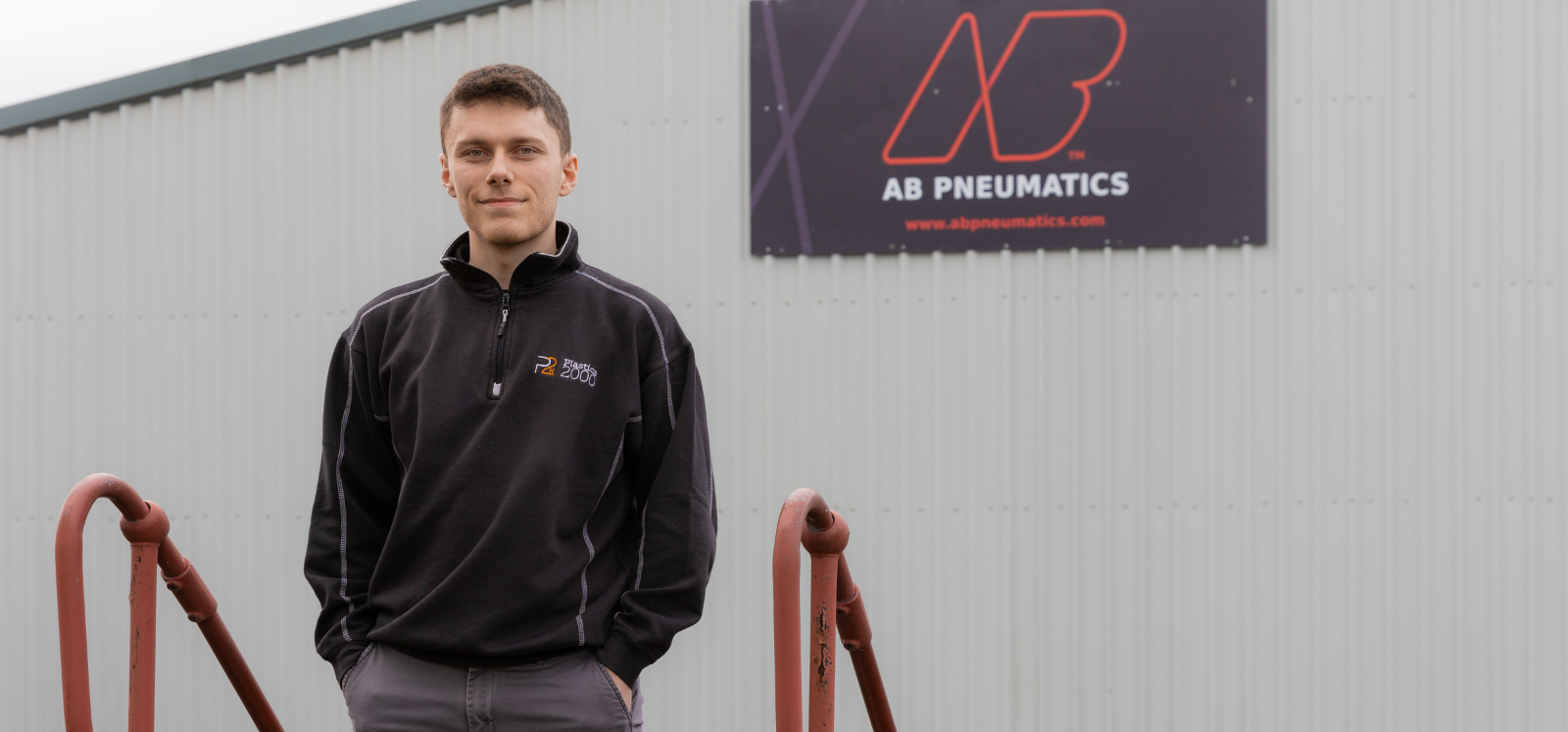
Q: You’ve recently completed your KTP project with sister organisations, AB Pneumatics and Plastics 2000. What sort of work were you doing as the KTP Associate?
A: My KTP focused on analysing and evaluating the structures of the two companies and implementing strategies to align them more effectively and strengthen their resilience. During the first few months of my KTP, it became apparent that both organisations were growing but didn’t have the appropriate foundations to build on.
My goal was to shift the management team’s focus from day-to-day firefighting to planning a long-term growth strategy. This involved cultural change on the factory floor, introducing lean manufacturing, and developing a new management team to oversee the running of both organisations simultaneously. We defined clear roles, responsibilities, and departments to improve communication and decision-making. The outcome is a new organisational structure where the goals and vision of both organisations are shared from top to bottom.
Q: When your KTP finished, you were offered a permanent position as Business Development Manager with the organisation. Can you tell us about that transition?
A: The transition into my new role has been seamless. A lot of my work throughout my KTP project was focused on restructuring both organisations under one management system, so I was always aware of the expectations and direction in which both organisations were heading. The KTP gave me an excellent opportunity to practice my leadership skills in managing numerous projects and I spent a lot of time working with the Senior Management Team that I am now part of. The idea of taking the step up to Senior Management was a daunting one, however, the final few months of my KTP project ensured that I was ready for that.
Q: As a Queen’s Business School graduate, how did your academic experience shape your KTP journey?
A: I completed my undergraduate degree in Business Management with Placement. I chose it because I wasn’t sure where I wanted to take my career, and it allowed me to keep my options open. The course gave me a broad grounding across areas such as marketing, operations, accounting and change management. I also completed a placement year with the Southern GP Federation, where I took on significant responsibility, from redeveloping their website to managing payroll and finance following my line manager’s departure. I’m grateful for my time at Queen’s as this mix of learning and first-hand industry experience gave me the confidence to step into my KTP role and eventually a senior management position.
Q: How did the partnership with Queen’s and your academic supervisor influence the project?
A: I had opportunities to visit other businesses, which helped me reflect on where improvements could be made at AB and P2K. My academic supervisor, Julie McCandless, was particularly supportive towards the end of the project, sharing valuable insight on data-driven decision-making, which is a key area for our future direction. She also provided excellent guidance on training and use of my budget, helping me invest in areas such as Six Sigma and Project Management that will benefit both my own development and the organisations going forward.
Q: Looking back, what outcomes from the KTP are you most proud of?
A: The biggest challenge, and the most rewarding part of the project, was driving culture change when introducing lean methodologies, particularly at AB Pneumatics. This involved leading meetings with operatives to get their buy in on what we were trying to achieve. Our aim was to give staff a platform to solve everyday problems that slowed them down or made their work harder, and to show that lean was about improving how work was done, not cutting costs or increasing workload. Early stand-up meetings were challenging, with little input at first, and I was concerned progress might stall. It took time to build trust and engagement, but within 12 months we implemented over 250 staff-led improvements, delivering around £20,000 in operational efficiencies. More importantly, the ‘us and them’ mindset disappeared, with operatives actively contributing ideas and taking ownership of change and an overall sense of togetherness and unity around our long-term ambitions now exists.
Another outcome I was particularly proud of was the creation of a joint senior management team across both organisations. Although it wasn’t the original goal, seeing the changes we implemented lead naturally to this stronger, more sustainable structure, supported by new roles and departments, felt like a true mark of the project’s success.
Q: In October 2025, you were named Future Leader at the Innovate UK KTP Awards - what did that recognition mean to you?
A: It was a huge honour as it is a highly competitive category, and I think it reflects the impact of the project. This recognition was made possible by the support from Queen’s, including targeted training that was crucial to my personal and professional development. Equally important was the backing of my company supervisor and Managing Director, whose support was vital in making decisions and bringing others along on the journey. The early months of the KTP were challenging, but the dual support model gave me the confidence to keep pushing forward and successfully complete the project.
Q: How did the KTP prepare you for a leadership role?
A: Throughout the project, I felt that I was naturally developing as a leader. I developed strong leadership and management skills, particularly in change management, people management and strategic thinking. I began to lead specific projects across the two organisations, reporting back to senior management, presenting findings and suggesting appropriate next steps. I have been encouraged to make my own decisions and been given opportunities to attend shows as a visitor and an exhibitor, where I have grown in confidence and learned more about the commercial thinking needed to grow a successful company.
Q: In your new role as Business Development Manager, how are you building on the KTP work?
A: Since moving into my new role as part of the senior management team, I am now heading the strategic direction for all Sales, Marketing and Business Development-related activities. My experience working alongside key members of our operational and technical departments will be key for what I do next. We are continuing to build on our work done during the KTP, focusing on strategic planning for growth. My personal aim is to strengthen my department by standardising our sales and marketing processes as I aim to build a team around me in the long-term. As I did during my KTP project, I will also continue to drive new paths for innovation such as implementing AI, developing new products and entering new markets.
Q: What would you say to graduates considering a KTP Associate role?
I’ve entered the manufacturing industry from a business management background, which is not something I had ever envisioned, but thankfully it’s worked out for the best. Despite the overwhelming prospect of spearheading a project with your own ideas, it is the perfect opportunity for you to grow personally and professionally having just completed your academic studies. It is the right blend of freedom to make your own decisions in a real business environment and at the same time, receiving guidance and support, if and when you need it. Of course, there is also the extra benefits of receiving a training budget to develop your own skills and gain further certifications etc. If there is a KTP role that you’re considering, don’t hesitate, just go for it.
See here for our current and upcoming KTP roles or contact us at ktp@qub.ac.uk for more information.