Trusted Research (Research Security)

Trusted Research aims to support the integrity of the system of international research collaboration, which is vital to the continued success of the UK’s research and innovation sector.
Trusted Research is particularly relevant to staff and students working in:
- STEM subjects
- Dual-use technologies
- Emerging technologies and/or
- Commercially sensitive research areas
The principles of Trusted Research apply equally to formal and informal collaborations, funded and non-funded partnerships.
In Summary Trusted Research
- Outlines the potential risks to UK research and innovation
- Assists researchers, UK universities and industry partners to have confidence in international collaboration and make informed decisions around potential risks.
- Explains how to protect research and staff from potential theft, misuse or exploitation.
National Protective Security Authority (NPSA) have created a specific guidance for academia in relation to Trusted Research. This guidance can be accessed via this link. To protect your research/international partnerships you must consider the following:
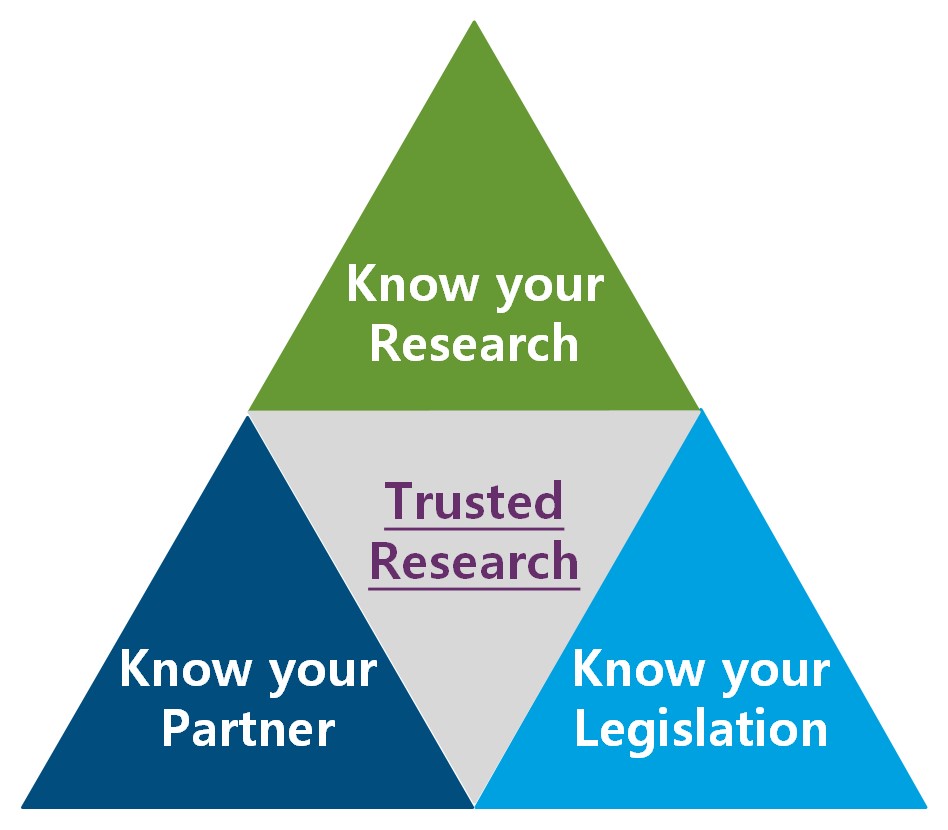
Any queries please contact: trustedpartnerships@qub.ac.uk
-
Know your Partner
Know your Partner
Undertaking due diligence on potential partners is critical to identifying potential risks and making an informed decision based on this knowledge. Due diligence activities undertaken should include:
- Review of UK and international sanctions lists (e.g. EU and US)
- Review of adverse media
- Reviewing partner’s online presence, including social media (This may provide information on beneficial ownership, current and past collaborators and current/past projects/outputs)
Questions that you should assess during your due diligence review include:
- Is your partner affiliated with any foreign military/intelligence/defence services?
- Does the potential collaboration/activity involve any conflict of interest? (E.g. Any existing contracts and/or relationships which could restrict your potential activities.)
- Could the partner be vulnerable to coercion by third parties? (Be aware of the local jurisdiction that your partner operates within.)
- Did you discover anything during your due diligence that does not align with what your partner has communicated to you?
- Know Your Research
Know Your Research
To make informed decisions, including implementation of mitigations where necessary, it is fundamental that the researcher critically assesses their research by considering the questions below.
- Are there any potential military or dual-use applications for your research?
- Are there any potential unethical applications for your research?
- Have you considered data access control measures?
- Have you considered IP protection for your research?
To assist in consideration of data access, the below points may be helpful.
- Is research data segregated? i.e. there is appropriate separation between research programmes/projects, both physically and online.
- Is access given to only those that have a valid reason to access the data?
- Are access logs and unsuccessful access attempts monitored? e.g. Is data being accessed at unusual times?
- If sharing information with your partners, are their systems suitably robust and secure to ensure protection of your data?
Further information and advice on cyber security can be obtained from the University’s Cyber Security department.
- Know Your Legislation
Know Your Legislation
It is important to ensure that you are aware of your legal requirements.
This awareness of legal obligations may include consideration of:
- Export Controls (UK and international)
- Academic Technology Approval Scheme (ATAS)
- Data Protection/GDPR
- National Security & Investment Act
- Sanctions
- Compliance in foreign jurisdictions (i.e. with the legislation of your partners’ countries.
- Failure to Consider Trusted Research Agenda
Failure to Consider Trusted Research Agenda
Failure to consider this important government led agenda can result in potential risk to the following:
- People: staff, students and researchers (Potential reputation and legal damages).
- Compromise/theft of research data including pre-publication and proprietary
- Protection of source code, prototypes, technical plans etc.
- Unauthorised network access
- Uncontrolled access to laboratory equipment and software
- Access to confidential information/documents
- Financial loss to individual researchers and institutions
- Reputation of individuals and institutions.
- Criminal prosecutions (individual and/or institutional)
-
Research Security Case Studies
The seven scenarios below are a series of short videos, based on real events that have occurred in UK academia. They have been developed by the NPSA and NCSC, under the Trusted Research advice and guidance, as learning resources to help academics identify and mitigate research security risks.
Scenario 1: Authoritarian Government
Scenario 2: Overseas Presentation and Government Approach
Scenario 3: Hosting Sensitive Data Overseas
Scenario 4: Talent Plan, Funding Conflicts and Changing Research Scope
Scenario 5: University Spin-Out
Scenario 6: Identifying Exports Controls and Sanctions
Scenario 7: Identifying Dual-Use Applications Before Commercialisation
Further information on the above scenarios, including video transcripts can be located here.
Further case studies from UK HEIs can be found in the below publication.
State Threats and Universities: Case Studies from the United Kingdom
-
Resources
NPSA Trusted Research Guidance for Academia
NPSA Trusted Research Countries and Conferences Guidance
NPSA Trusted Research Campaign Materials
NPSA -Shared workspace
NPSA Trusted Research - Senior Leaders
NSI Act: guidance for the higher education and research-intensive sectors
Universities UK, UKRI and National Protective Security Authority (NPSA) overview of Higher Education guidance on managing security-related issues (PDF, 350KB)
Universities UK: managing risks in internationalisation: security related issues
UUK & British Council: Managing risk and developing responsible transnational Education (TNE) partnershipsUniversity Export Control Policy
G7 Best Practices for Secure & Open Research
G7 Common Values and Principles on Research Security and Research Integrity
-
Contact Details
Should you have any queries regarding Trusted Research, please email trustedpartnerships@qub.ac.uk