Queen’s University research drives real world response to Violence Against Women and Girls
A leading researcher in Violence Against Women and Girls has stressed the vital role of sustained partnership working to translate research into meaningful action.
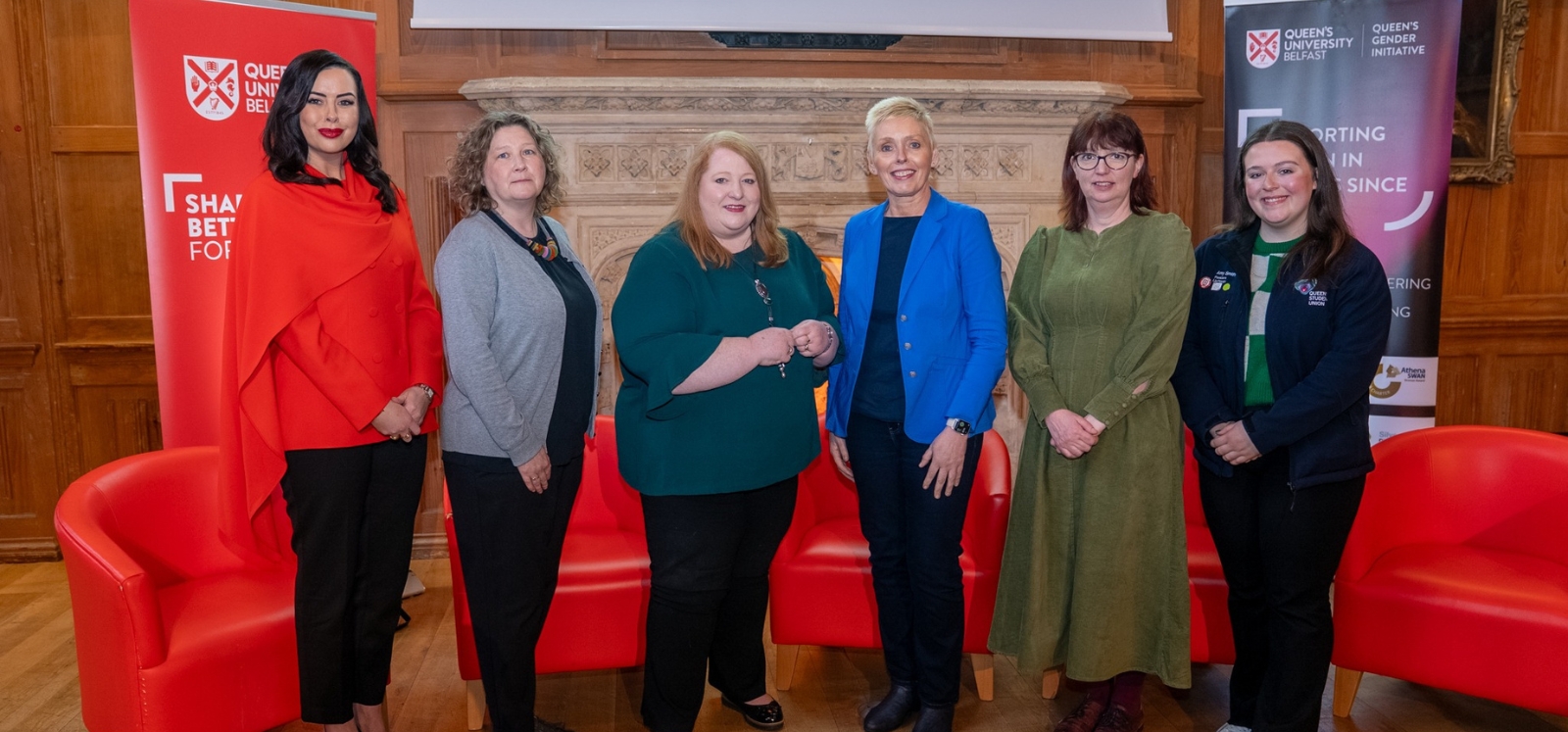
Speaking at an event at Queen’s marking International Women’s Day 2026 and celebrating the Women of Queen’s, Dr Siobhán McAlister, a Reader in Criminology, and a member of the Centre for Children’s Rights at Queen’s University Belfast says that while research is the key first step, continued partnership working is key to effectively tackling Violence Against Women and Girls.
She said: “Research is crucial in understanding the scale and experience of violence against women and girls, and exposing how everyday violence becomes normalised. But it’s not the whole story. Our research is designed to translate what we learn about the realities for young women and girls into real life action, and none of this can be achieved in isolation.
“A huge amount of work is now taking place in partnership across universities, government and public bodies, with all of us having a responsibility to drive and deliver a real world response.”
Dr McAlister was speaking at Strength in Action: Educate, Support, Inspire, a Women of Queen’s event hosted by Radio Presenter Rebecca McKinney. Attended by more than 100 women graduates, students and supporters of Queen’s, the event focussed on how Violence Against Women and Girls is being addressed, while also celebrating the achievements of women across the Queen’s community in leadership, innovation, resilience and female advocacy.
Addressing the audience on the government strategy, Northern Ireland Minister of Justice, Naomi Long, said: “As Justice Minister, I am painfully aware that domestic and sexual abuse remains one of the most pervasive harms affecting people across Northern Ireland. These crimes disproportionately affect women and girls.
“The justice response to violence against women and girls has continued to evolve through legislative reform, strengthened victim support and clearer accountability for perpetrators.
“One of the most transformative ways that a justice system can protect victims is by having effective legal measures in place and, as Justice Minister, I have sought to bring forward legislation that equips police and the courts to respond to abuse and violence.
“It is any individual’s choice about whether they wish to report abuse, but I would always encourage anyone to come forward and avail of the various supports that are available.”
Highlighting the impact of women connected to the University, Queen’s Vice-Chancellor Professor Sir Ian Greer said: “Women have long made their mark at Queen’s University - from pioneering innovative research on global diseases such as Multiple Sclerosis, cancer and eye disease to leading the way in the arts, politics, policing, business and engineering. Our University is proud of the impact the women of Queen’s continue to make across the globe, the inspiration they provide to other generations and the legacy they have built.”
Also speaking was Queen’s Pro-Vice-Chancellor, Professor Margaret Topping, who said: “International Women’s Day challenges us not simply to celebrate progress, but to accelerate it. Real change requires collaboration, across disciplines, across sectors and across generations.
“Today is a reminder that when women educate, when women support one another, and when women inspire action, institutions transform and societies follow.”
Media
For further information contact Ciara.oneill@qub.ac.uk