- Date(s)
- March 20, 2026
- Location
- Senate Room, Lanyon Building, Queen’s University Belfast
- Time
- 12:00 - 13:30
- Price
- Free
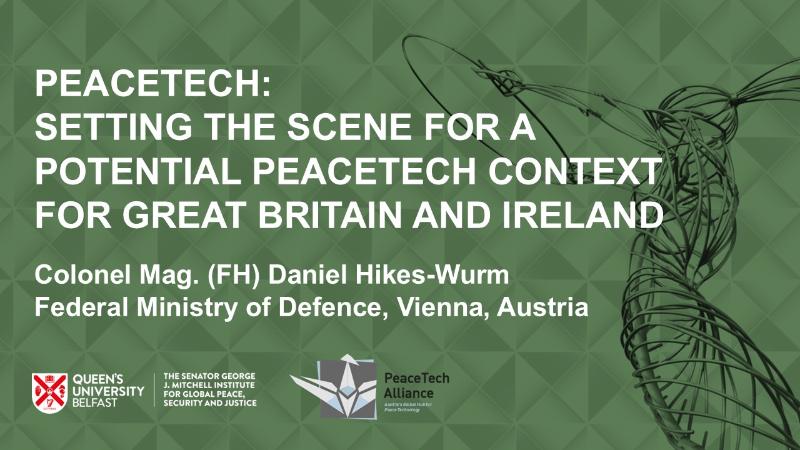
Speaker: Colonel Mag. (FH) Daniel Hikes-Wurm, Federal Ministry of Defence, Vienna, Austria
Facilitator: Nathan Coyle, PeaceTech
This workshop introduces PeaceTech in clear, accessible terms and explores what it could mean in the specific contexts of Great Britain and Ireland.
The session will begin by outlining what PeaceTech is, how it is currently being used, and where it is already influencing peacebuilding, diplomacy, and conflict prevention. It will explore both the potential and the limitations of PeaceTech, including ethical considerations, questions of data governance, and the importance of human-centred design. The focus is on PeaceTech as a practical, evolving field that should be shaped by real-world needs rather than abstract technological ambition.
Technology is increasingly intertwined with conflict, governance, and social cohesion. In 2025, with global and regional dynamics remaining highly volatile, there is a growing need to strengthen how technology is understood and used in support of peace. This workshop will consider what that means not only in a global sense, but also within domestic settings across Great Britain and Ireland, where issues such as polarisation, trust, misinformation, and social division continue to have tangible effects.
Belfast provides a particularly meaningful setting for this conversation. Its experience of conflict, peace processes, and post-conflict transformation offers valuable insight into how PeaceTech could be informed by local histories and lived experience, and how those insights might shape PeaceTech thinking across the islands.
The workshop will include participatory elements throughout. Participants will be invited to share their perspectives and experiences, and to reflect on where and how PeaceTech could be most useful in domestic contexts. This may include community-level dialogue, education and training, civic participation, early warning, or trust building between institutions and communities.
The discussions and insights from the workshop will inform a short written paper capturing key themes, reflections, and emerging considerations for PeaceTech in the contexts of Great Britain and Ireland. This paper will be shared publicly following the event.
This workshop is hosted in partnership with the PeaceTech Alliance.
Colonel Mag. (FH) Daniel Hikes-Wurm
Colonel Mag. (FH) Daniel Hikes-Wurm, MAS MA works in the Directorate General for Defence Policy of the Federal Ministry of Defence, Vienna, Austria, as a Senior Advisor for Defence Policy.
His work focuses on the security and defence policy implications of technological developments, including Artificial Intelligence and other emerging and disruptive technologies, cyber defence policy, and hybrid threats. Daniel will explore what digital security looks like in practice from an Austrian perspective and across the European Union, and what this means for peace.
Nathan Coyle
Nathan Coyle is the co-founder of the PeaceTech Alliance, which is hosted by the Austrian Institute of Technology. The PeaceTech Alliance works across Austria with government, research institutions, civil society, and other stakeholders, and is increasingly active at the European Union level. This includes engagement with EU policy processes and education and training initiatives, including collaboration with the European Security and Defence College.
Nathan sits on the EU EAB.Cyber Board and has worked with the Organisation for Security and Co-operation in Europe to help shape emerging PeaceTech narratives. He has also briefed the UN Cyber Hub on data governance and PeaceTech-related approaches.
He has worked with central governments across Europe, the Americas, and other regions, supporting initiatives on peacebuilding, digital governance, open data, and citizen engagement. His work focuses on the practical and ethical use of technology, data, and AI in peacebuilding, diplomacy, and conflict prevention, with an emphasis on human-centred design, data sovereignty, and grounding technological approaches in lived experience.
Nathan is the author of Open Data for Everybody: Using Open Data for Social Good, published by Routledge in 2024, and has delivered a TEDx talk on the role of data, technology, and power in shaping more inclusive and peaceful futures.