In this mini-showcase, Arts Management & Cultural Policy at Queen’s is delighted to present the research in progress of two PhD candidates within this broad interdisciplinary field.
- Date(s)
- April 21, 2026
- Location
- Drama Studio, Drama & Film Centre, 20 University Square, Queen’s University Belfast
- Time
- 16:30 - 18:00
- Price
- Free
Each is exploring dimensions of crisis and vulnerability, on the one hand, how cultural organisations made decisions during a crisis; on the other how cultural work and specifically work within theatre rehearsals rooms and dramaturgy can expose or enhance vulnerability of practitioners and what steps might be needed to mitigate this. Each of our speakers will do a short presentation – details below. An opportunity for a short Q&A for both presenters will be chaired by Ali FitzGibbon from the School of Arts, English & Languages at QUB.
Presentation 1: Decision-making in response to crisis; an institutional logics study of in the cultural sector – Fiona Lowe
This presentation applies an institutional logics framework (Friedland & Alford, 1991; Thornton, Ocasio & Lounsbury, 2012) to examine how not‑for‑profit cultural organisations navigated digital decision‑making focusing on the exacerbated omni-crisis period of the COVID19 pandemic and ensuing lockdowns. Within the cultural sector, digital activity has often been regarded as peripheral to an organisation’s core mission. The Covid‑19 pandemic fundamentally disrupted this dynamic. When physical venues closed in March 2020, digital platforms became the sole means of public engagement, exposing widespread unpreparedness and revealing a reactive rather than strategic approach to digital adoption.
Empirical research was conducted in 14 cultural organisations in Northern Ireland. This included museums, performing arts companies, libraries, galleries, heritage sites, and community arts groups with different scales of capacity for digital. Interviews with 23 senior and mid‑level staff explored how decisions were made, who made them, and how competing logics shaped organisational responses during the lockdown periods from March 2020 to October 2021.
This presentation will highlight the study’s findings to date. Organisations and staff faced the same crisis simultaneously but their decision‑making diverged significantly. Some responses appeared broadly isomorphic, reflecting shared challenges and sector‑wide constraints, reflecting the significance of human agency. From staffing choices to programming and financing decisions, organisations and staff improvised, experimented, and navigated tensions between conservatism and innovation, and between gatekeeping and change‑making.
The talk will highlight the interplay of artistic, economic, social, and digital logics during a period of acute disruption. While institutional logics can shift under pressure, many organisations ultimately reverted to familiar “iron cage” norms (DiMaggio & Powell, 1983), revealing deep‑rooted structural precarity that limits preparedness for crisis. The study also exposes challenges of short‑termism and limited digital capacity.
Presentation 2: Managing Risk and Vulnerability: Dramaturgical Practices in Precarious Rehearsal Rooms - Kristýna Ilek
In the precarious landscape of contemporary performance-making, creativity still requires a degree of vulnerability: the willingness of artists to take risks, explore unfamiliar topics and materials and engage emotionally, intellectually and physically with their work. Such vulnerability would ideally be held within rehearsal environments that are safe, ethical and supportive, though this is not always the case in practice. On the island of Ireland, where precarity in the form of unstable funding, uneven access to resources and limited social security, shapes the lives of theatre makers, the question of how to enable vulnerability while ensuring safeguarding becomes central to the sustainability of creative practice.
Drawing on interviews with directors, dramaturgs, stage managers, producers, performers and other theatre makers working in Northern Ireland, the Republic of Ireland and across both jurisdictions, this study traces the strategies that theatre-makers use within rehearsal rooms to allow for vulnerability while ensuring safeguarding. I suggest that looking at these strategies and practices as dramaturgical strategies allows for creative risk-taking while attending to the well-being of individuals and ensembles. By linking artistic vision to working conditions in the rehearsal room, dramaturgy foregrounds the interdependence of creative labour and care, framing vulnerability not as exposure to harm but as a generative and necessary condition for creativity, supported through clear boundaries, shared responsibility and ethical practice. Situated within broader discourses of care ethics, emotional labour and safeguarding, I argue in this presentation that sustainable performance-making in Irish theatre emerges through dramaturgical approaches that hold space for risk-taking as well as vulnerability while maintaining safe and supportive rehearsal environments.
Attendance is free but booking is required due to limited capacity.
Light refreshments will follow the talk.
This event is made possible with the assistance of the School of Arts English & Languages through the Arts CDRG.
Speaker bios:
Kristýna Ilek (she/her) is a PhD candidate in Drama, supported by the Department of Economics Studentship. She researches working conditions, care and power relations in the performing arts with a focus on their impact on creative processes and wellbeing in rehearsal rooms on the island of Ireland. Her work also examines how dramaturgical practices impact artistic environments. She is a Teaching Assistant and Peer Mentor at School of Arts, English and Languages. Additionally, Kristýna is a freelance dramaturg and creative producer of European art collective Dare to Care Art.
Fiona Lowe is a final‑year ESRC‑funded PhD researcher in Arts Management and Cultural Policy at Queen’s University Belfast. Her doctoral work explores how cultural institutions make decisions in a time of crisis. Fiona previously completed an MA in Arts Management and Cultural Policy and an undergraduate degree in French and History of Art at Queen’s University Belfast. Alongside her research, she is an AHSS Student Skills Assistant, delivering workshops on digital, academic, and future‑ready skills. Before beginning her PhD, Fiona worked in the creative sector as an arts administrator and practising fine artist, and she remains committed to strengthening Northern Ireland’s cultural landscape.
Image acknowledgments:
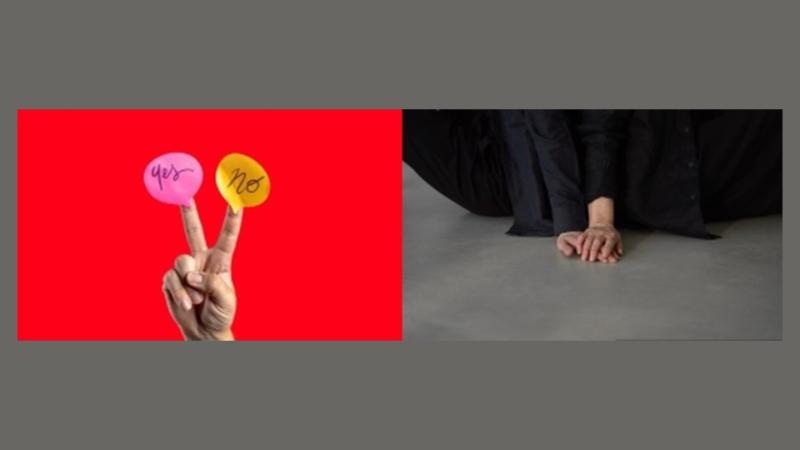
Cropped image of two people in dark outfit touching hands on floor by Scopio; Hand making V-sign with "yes" and "no" speech bubbles on red background by Giuseppe Lombardo both from https://thenounproject.com (CC BY-NC-ND 2.0)
For details on location and accessibility: https://www.accessable.co.uk/queen-s-university-belfast/access-guides/20-university-square-01-006 (Please note once inside the building, the drama studio is on the first floor with lift access).