Robin Harland Award presentation
The QUB General Practice Team was delighted to visit Corran Surgery, Larne, on 4 March 2026 to present the 2024-25 Robin Harland Prize for Excellence in Undergraduate Education to Dr Gordon Alexander.
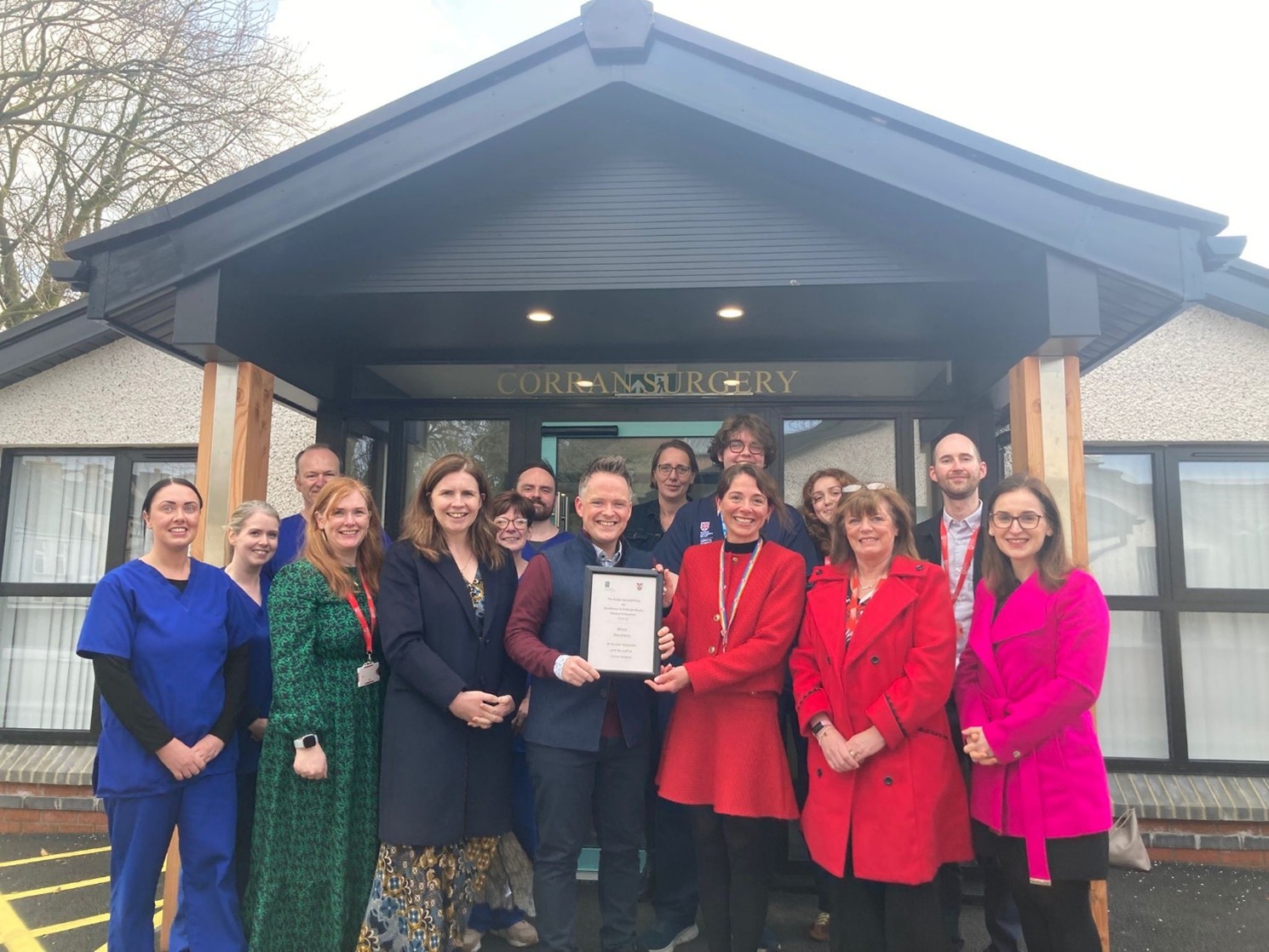
Prof Helen Reid (QUB Associate Director for General Practice and Primary Care) and Prof Kathy Cullen (QUB Director of Centre for Medical Education) presenting Dr Gordon Alexander with his award. Joined by Dr Orla Laverty (Northern Area Locality Lead at the GP Sub Deanery), QUBGP team colleagues and staff and students at Corran Surgery.
About the Prize
The Prize honours Dr Robin Harland, a QUB graduate and long‑serving GP, educator and advocate for the development of General Practice teaching in Northern Ireland. His legacy includes a deep commitment to high‑quality undergraduate education. The Prize is awarded annually to the QUB GP tutor and practice judged—based on student nominations—to have delivered an outstanding educational experience.
How the Prize Is Awarded
Year 4 and Year 5 medical students nominate GP tutors and practices who have made a significant impact on their learning. Nominations are reviewed anonymously by an independent panel. This year’s adjudicators, Dr Ursula Mason and Professor Nigel Hart, reflected on the exceptional standard of submissions:
“Students described transformative experiences and practice teams who embedded them fully in day‑to‑day work. Many spoke of inspirational placements that allowed them to grow, develop and flourish.”
Celebrating the 2024–25 Recipient: Dr Gordon Alexander
This year’s Prize was awarded to Dr Gordon Alexander, GP Partner at Corran Surgery, MSK clinician and Board Member within the East Antrim Federation, NIMDTA GP Trainer, and QUB Undergraduate Tutor. Gordon’s professional journey—and his passion for education—were central to why students described their time at Corran Surgery as “the highlight of medical school.”
Gordon’s path into General Practice
Gordon studied medicine at the University of Newcastle, where primary care was woven throughout all five years of the curriculum. Early and meaningful exposure to GP shaped his understanding of medicine:
- He found GP mentors who were “interested and interesting,” deeply rooted in their communities, and committed to students’ development.
- He experienced the breadth and reality of primary care—from home visits to unexpected community encounters (including with poodles Pixie and Pebbles!)—which he describes as “real, gritty, and the highlight of my undergraduate experience.”
- Although he enjoyed every specialty during Foundation Training, it was the continuity, variety and humanity of General Practice that “hooked” him.
His GP training in Northumbria included an influential integrated post in palliative care, which continues to shape his clinical work today.
Returning Home to Larne
Gordon grew up in Larne and never imagined he would return to practise there. A chance conversation with a senior partner led to locum work, then a salaried post, and eventually partnership:
“It was a risk returning to a place and people you know personally—what if it wasn’t what you remembered? What if they don’t like you? Am I good enough?”
What he found instead was a deep sense of connection and privilege:
“I had a unique insight into our patients—I knew them, their families, their experiences. I had lived similar. I was them.”
Why Gordon Is Committed to Training
This is the heart of Gordon’s story—and the reason his students speak so powerfully about their time with him.
Why he teaches
Gordon describes General Practice as endlessly varied, intellectually demanding, and profoundly human:
“No two days are the same, no two patients are the same, and you always need your wits about you.”
He sees medical training as an apprenticeship—skills learned not only from books but from being alongside clinicians in the real world:
“There is something visceral about being in someone’s home—seeing their vulnerabilities, worries and hopes in stark reality.”
Why Corran Surgery embraced undergraduate teaching
Historically, Corran Surgery was not a teaching or training practice. Many colleagues wondered whether they had anything to offer or enough time to teach. But the experience of hosting QUB students changed the practice:
- The admin team became a welcoming committee.
- Clinicians rediscovered the value of their everyday work through students’ eyes.
- Patients felt proud to contribute to training the next generation.
- The whole team gained confidence and energy from the experience.
Gordon reflects:
“Students brought a fresh take on medicine for us all. What we saw as routine, they saw as inspiring—and we all learned from the experience.”
Undergraduate teaching helped pave the way for Corran Surgery becoming an accredited NIMDTA GP Training Practice last year—something Gordon describes as a natural and exciting progression.
Highlights from the Winning Student Nomination
The Year 5 student who nominated Gordon wrote:
“The seven weeks I spent at Corran Surgery were by far the highlight of my medical school experience. From day one, I felt like a valued member of the team.”
“I learned about the power of good communication, especially watching Dr Alexander speak with families about difficult topics such as what a ‘good death’ might look like.”
“My experience at Corran Surgery helped me realise my true potential and fall back in love with medicine. It has given me clarity about the kind of doctor I want to be—hopefully a GP.”
Thanks
The QUB GP team are very grateful to the entire Corran Surgery team for their warm welcome and hospitality. Particular thanks to Mrs Eveline Burns (QUBGP Admin Lead) and Mrs Shauna McKinley (Practice Manager at Corran Surgery) for enabling all the practical aspects of the event.
Download report: RHA_presentation_report.docx