- medicine-mb-a100
- computer-science-meng-g402
- business-information-technology-incl-professional-experience-bsc-gn51
- software-engineering-placement-meng-g605
- computer-science-incl-professional-experience-meng-g405
- software-engineering-meng-g602
- data-science-year-professional-experience-bsc-g420
- software-engineering-placement-beng-g604
- modern-languages-business-ba
- social-work-relevant-degree-entry-bsw-l501
- social-work-bsw-l500
- criminology-sociology-ba-ml93
- psychology-bsc-c800
- spanish-ba-r410
- spanish-portuguese-ba-rr45
- criminology-ba-m900
- social-policy-sociology-ba-ll43
- sociology-ba-l300
- criminology-social-policy-ba-ml94
- pharmaceutical-biotechnology-sandwich-bsc-b213
- pharmaceutical-sciences-sandwich-bsc-b211
- pharmaceutical-biotechnology-bsc-b212
- pharmacy-mpharm-b230
- politics-sociology-ba-ll23
- politics-philosophy-economics-ba-lv00
- politics-spanish-ba-lr24
- anthropology-sociology-ba
- politics-ba-l200
- pharmaceutical-sciences-bsc-b210
- dentistry-bds-a200
- professional-nursing-learning-disabilities-nursing-bsc-b761
- professional-nursing-mental-health-nursing-bsc-b760
- professional-nursing-children-young-people-bsc-b730
- professional-nursing-adult-nursing-bsc-b740
- midwifery-bsc-b720
- accounting-major-french-bsc-n4r1
- accounting-major-spanish-bsc-n4r4
- actuarial-science-risk-management-bsc-n323
- advanced-accounting-placement-macc-n400
- aerospace-engineering-beng-h400
- aerospace-engineering-meng-h402
- aerospace-engineering-sandwich-beng-h404
- aerospace-engineering-sandwich-meng-h405
- agricultural-sciences-bsc-d700
- agricultural-sciences-bsc-d704
- anthropology-archaeology-ba-lv64
- anthropology-ba-l600
- anthropology-english-ba-ql36
- anthropology-french-ba-rl16
- anthropology-history-ba-vl16
- anthropology-international-relations-ba-ll6f
- anthropology-irish-ba-ql56
- anthropology-philosophy-ba-lv65
- anthropology-politics-ba-ll62
- anthropology-spanish-ba-lr64
- applied-mathematics-physics-bsc-gf13
- applied-mathematics-physics-msci-gfc3
- archaeology-ba-v402
- archaeology-french-ba-v4r1
- archaeology-history-ba-vv41
- archaeology-irish-ba-vq45
- archaeology-portuguese-ba-v4r5
- archaeology-spanish-ba-v4r4
- archaeologypalaeoecology-bsc-v400
- archaeologypalaeoecology-geography-bsc-vf48
- architecture-bsc-k100
- audio-engineering-bsc-j930
- biochemistry-bsc-c700
- biochemistry-bsc-c704
- biochemistry-msci-c702
- biochemistry-msci-c705
- biological-sciences-bsc-c100
- biological-sciences-bsc-c104
- biological-sciences-msci-c102
- biological-sciences-msci-c105
- biomedical-science-bsc-b940
- business-economics-bsc-l110
- business-management-placement-bsc-n202
- chemical-engineering-beng-h800
- chemical-engineering-meng-h802
- chemical-engineering-year-industry-meng-h805
- chemistry-bsc-f100
- chemistry-mchem-f105
- chemistry-year-industry-bsc-f104
- chemistry-year-industry-mchem-f107
- civil-engineering-beng-h200
- civil-engineering-meng-h202
- civil-engineering-year-industry-beng-h204
- civil-engineering-year-industry-meng-h205
- computer-engineering-beng-gh6p
- computer-engineering-meng-gh6q
- computer-engineering-year-industry-beng-gh67
- computer-engineering-year-industry-meng-gh68
- computer-science-professional-experience-bsc-g400
- computing-information-technology-incl-professional-experience-bsc-gg45
- drama-ba-w400
- drama-english-ba-wq43
- economics-accounting-bsc-ln14
- economics-bsc-l100
- economics-major-finance-bsc-l1n3
- economics-major-french-bsc-l1r1
- economics-major-spanish-bsc-l1r4
- education-studies-ba-x200
- education-studies-social-policy-ba-xl24
- education-studies-sociology-ba-xl23
- electrical-electronic-engineering-beng-h600
- electrical-electronic-engineering-meng-h602
- electrical-electronic-engineering-sandwich-beng-h604
- electrical-electronic-engineering-sandwich-meng-h605
- english-ba-q300
- english-creative-writing-ba-q3w8
- english-film-studies-ba-qw36
- english-french-ba-qr31
- english-history-ba-qv31
- english-irish-ba-qq53
- english-linguistics-ba-qq31
- english-philosophy-ba-qv35
- english-politics-ba-ql32
- english-sociology-ba-ql33
- english-spanish-ba-qr34
- environmental-civil-engineering-meng-h252
- environmental-civil-engineering-year-industry-meng-h255
- environmental-management-bsc-f850
- environmental-management-bsc-f854
- european-planning-mplan-k490
- film-studies-production-ba-w600
- film-theatre-making-ba-ww65
- finance-year-industry-bsc-n300
- financial-risk-management-year-industry-bsc-n390
- food-science-nutrition-bsc-bdk6
- food-science-nutrition-bsc-db6k
- food-science-nutrition-msci-bd46
- food-science-nutrition-msci-db64
- french-ba-r120
- french-history-ba-rv11
- french-international-relations-ba-rlc2
- french-irish-ba-qr51
- french-politics-ba-rl12
- french-portuguese-ba-rr15
- french-spanish-ba-rr14
- games-technologies-bsc-g455
- geography-ba-l800
- geography-bsc-f800
- geography-language-bsc-f8rx
- history-ba-v140
- history-international-relations-ba-lv21
- history-philosophy-ba-vv1m
- history-politics-ba-vl12
- history-sociology-ba-vl13
- history-spanish-ba-rv41
- human-biology-bsc-b100
- international-business-major-french-bsc-n1r1
- international-business-major-german-bsc-n2r2
- international-business-major-mandarin-bsc-n1r9
- international-business-major-portuguese-bsc-n2r5
- international-business-major-spanish-bsc-n1r4
- international-relations-conflict-studies-ba-l253
- international-relations-irish-ba-lqf5
- international-relations-politics-ba-l290
- international-relations-spanish-ba-lrf4
- irish-ba-q504
- irish-broadcast-production-ba-qp53
- irish-politics-ba-ql52
- irish-portuguese-ba-qr55
- irish-spanish-ba-qr54
- law-llb-m100
- law-major-french-llb-m2r1
- law-major-irish-llb-m2q5
- law-major-politics-llb-m1l2
- law-major-spanish-llb-m2r4
- law-senior-status-llb-m101
- liberal-arts-blibarts-y301
- liberal-arts-mlibarts-y300
- marine-biology-bsc-c160
- marine-biology-bsc-c164
- marine-biology-msci-c162
- marine-biology-msci-c165
- mathematics-bsc-g100
- mathematics-computer-science-bsc-gg41
- mathematics-computer-science-msci-ggk1
- mathematics-finance-bsc-g1n3
- mathematics-french-bsc-g1r1
- mathematics-mmath-g103
- mathematics-spanish-bsc-g1r4
- mathematics-statistics-op-research-bsc-gg13
- mathematics-statistics-op-research-mmath-ggc3
- mechanical-engineering-beng-h300
- mechanical-engineering-meng-h303
- mechanical-engineering-sandwich-beng-h304
- mechanical-engineering-sandwich-meng-h305
- media-broadcast-production-ba-p310
- medicinal-chemistry-bsc-f150
- medicinal-chemistry-mchem-f15a
- medicinal-chemistry-year-industry-bsc-f154
- medicinal-chemistry-year-industry-mchem-f15c
- microbiology-bsc-c500
- microbiology-bsc-c504
- microbiology-msci-c502
- microbiology-msci-c505
- music-audio-production-ba-w374
- music-bmus-w302
- music-performance-ba-w310
- music-sound-design-ba-w371
- philosophy-ba-v500
- philosophy-politics-ba-vlm2
- physics-astrophysics-bsc-f3f5
- physics-astrophysics-mphys-f3fm
- physics-bsc-f300
- physics-french-bsc-f3r1
- physics-french-mphys-f3rc
- physics-medical-applications-bsc-f3b9
- physics-medical-applications-mphys-f3bx
- physics-mphys-f303
- physics-spanish-bsc-f3r4
- physics-spanish-mphys-f3rq
- planning-environment-development-bsc-k430
- structural-engineering-architecture-meng-h2k1
- structural-engineering-architecture-year-industry-meng-h2kc
- theoretical-physics-bsc-f340
- theoretical-physics-mphys-f344
- veterinary-biosciences-bsc-d300
- veterinary-biosciences-bsc-d304
- veterinary-biosciences-msci-d302
- veterinary-biosciences-msci-d305
- zoology-bsc-c300
- zoology-bsc-c301
- zoology-msci-c302
- zoology-msci-c305
BA | Undergraduate
Anthropology and Sociology
- Entry year
- Academic Year 2027/28
- Entry requirements
- ABB
- Attendance
- 3 years (Full-time)
6 years (Part-time)
This degree programme provides students with an education in two key closely related disciplines, anthropology and sociology. Social anthropology is the study of the social life of humankind and how this varies across different human cultures and societies past and present. Sociology developed as the scientific study of human society with a focus on social structure, social reproduction and social change and on how groups and individuals are influenced by norms, roles, and institutions. Together, the two disciplines provide students with a well-rounded understanding of human social life, including its range, cultural diversity and development over time, while also identifying the applied potential of this area of learning to the world we live in today.
Course highlights
Global Opportunities
Students have the opportunity to spend part of the course studying in other European universities, through our Erasmus programme, and also in the USA and Canada.
https://www.qub.ac.uk/schools/happ/student-experience/international-student-experience/
Career Development
Queen’s is ranked in the top 170 in the world for graduate prospects (QS Graduate Employability Rankings 2022).
Studying for a degree in Anthropology and Sociology at Queen‘s will assist students in developing the core skills and employment-related experiences that are valued by employers and academic institutions.
World Class Facilities
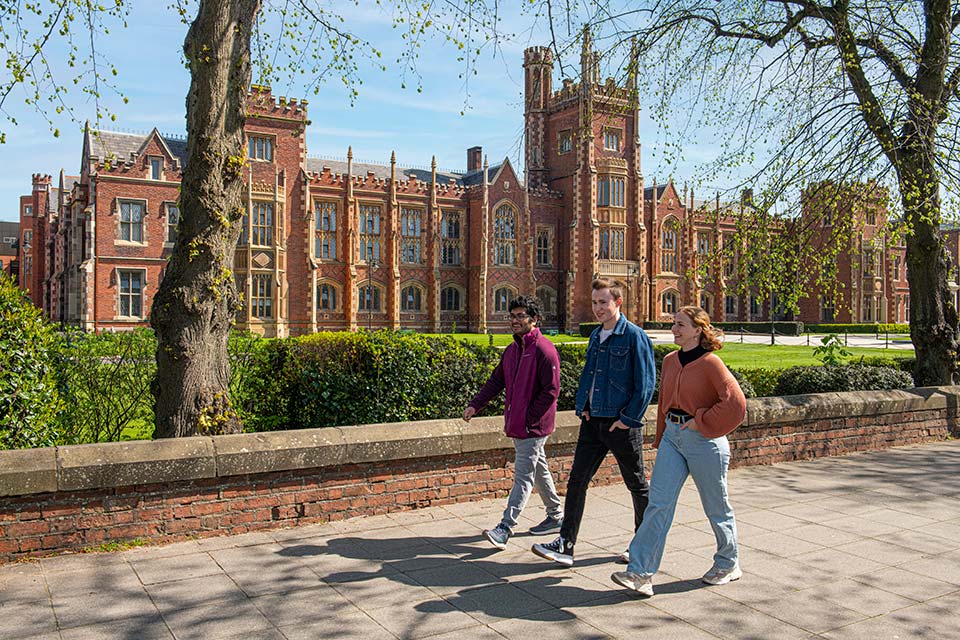
Queen’s is one of the top 10 most beautiful universities in the UK (Times Higher Education, 2023).
Students also benefit from access to a wide range of software packages, with training available in industry-standard tools for qualitative and quantitative analysis, such as SPSS and NVivo.
Also, enjoy the outstanding facilities of the McClay Library, home to 1.2 million volumes and 2,200 reader spaces.
https://youtu.be/vB0jafwkgd0
The School of History, Anthropology, Philosophy and Politics at Queen‘s has over 70 full-time academics, making it the largest institutional centre for the study of these subjects in Ireland and one of the largest in the UK.
The School also boasts the following:
Centre for Creative Ethnography
Institute of Cognition and Culture
Institute of Irish Studies
The Senator George J Mitchell Institute for Global Peace, Security and Justice
Two International Summer Schools (the Irish Studies Summer School & the Conflict Transformation and Social Justice Summer School)
The School of Social Sciences, Education and Social Work combines five core disciplinary areas, in Criminology, Education, Social Policy, Social Work and Sociology. It is a vibrant and intellectually diverse academic community that shares a single core vision: to produce world-leading research and first-class teaching, which expands knowledge, informs policy and practice and makes a social difference locally, nationally and globally. It includes:
The Centre for Child, Youth and Family Welfasre
The Centre for Children's Rights
The Centre for Inclusion, Transformation and Equality (CITE)
The Centre for Language Education Research
The Centre for Shared Education
The Centre for Technological Innovation, Mental Health and Education (TIME)
Internationally Renowned Experts
he anthropology team at Queen’s consists of ten members of staff at the cutting edge of research and publication, with specialisms in ethnomusicology, cognitive anthropology, conflict and peacebuilding, material culture, migration and diasporas, human-animal relations, and creative ethnography. Anthropology staff have a range of regional specialisms, including the UK and Ireland, the Mediterranean, the Roma, Australia, and Japan.
Sociology at Queen’s is made up of a team of internationally recognized scholars, passionate about exploring key social issues like family, religion, conflict, migration, ethnicity, norms, social movements, and social change. We offer a high quality, supportive, student-centred learning experience in a top Russell Group University.
Curious to learn more about our anthropology and sociology teams and their research? Please visit:
https://www.qub.ac.uk/schools/happ/subject-area/anthropology/people/
and
https://www.qub.ac.uk/schools/ssesw/subject-area/sociology/
Student Experience
Northern Ireland's post-conflict society offers a globally significant location for studying key social and cultural themes, including cultural politics. Our international links not only provide students with opportunities to study abroad, but also contribute to a diverse, international, student body. Queen’s currently has over 4400 international students from over 90 different countries (Queen’s Planning Office, 2024). Our uniquely supportive pastoral care / personal tutor system is equalled only by the academic guidance available.
Further Study Opportunities
or those wishing to pursue further study after their first degree, Anthropology at Queen’s offers an MA programme, each of which can be taken either full-time (one year) or part-time (two years). See the School website for information:
https://www.qub.ac.uk/courses/postgraduate-taught/anthropology-ma/
Within Sociology, we offer the MRes in Social Science Research, which provides the opportunity to develop and significantly advance skills in research methods, as well as substantive topics and theoretical debates. We also have a new MSc Sociology and Global Inequality programme which launched in September 2024.
http://www.qub.ac.uk/ssesw
NEXT
Course content
Course Structure
People teaching you
School of SSESW
Dr Cathal McManus’ research and teaching focuses on extremism and explores how long-term processes of identity formation (individual and group) can generate the conditions for conflict.
School of SSESW
Dr Catherine McNamee’s research centres on family dynamics and union formation, family and relationship wellbeing, and how these are shaped over the life course. She teachings quantitative methodology modules and Modern Families: Intimate and Personal Relationships.
School of SSESW
Dr Emma Calvert’s research interests have included the areas of employment, education, social inequalities and housing. She teaches on the courses Quantitative Research Skills and Social Inequalities and Diversity.
School of HAPP
Dr Evi Chatzipanagiotidou is a political anthropologist researching conflict and peace and the politics of memory and loss. She has conducted research in Cyprus, Turkey, Greece, and the UK. She teaches the courses Being Human: Culture and Society and Remembering the Future: Violent Pasts, Loss, and the Politics of Hope.
School of HAPP
Dr Ioannis Tsioulakis is an ethnomusicologist with a focus on popular music industries. His main fieldwork is in Greece. He teaches on the courses Popular Musics and the Anthropology of Music.
School of SSESW
Dr Jonathan Heaney’s current research explores the intersections of emotions and power from a political sociology of emotions perspective, focusing on the ’emotional state’, embodied nationalism, and on party politics more generally. He primarily teaches courses on social theory and the political sociology of emotions at both undergraduate and postgraduate levels.
School of HAPP
Dr Paulo Sousa is a cognitive anthropologist who works on evolution and morality, including moral psychology, inter-group conflict, and religion. He teaches the courses Key Debates in Anthropology and Human Morality.
School of HAPP
Dr Raluca Roman does fieldwork among the Roma people in Finland and Romania and specialises in the study of religion (specifically Christianity). She teaches the courses In Gods We Trust: The New Anthropology of Religion and Anthropology and Roma.
School of SSESW
Dr Rin Ushiyama is a cultural and political sociologist interested in the competitive processes surrounding collective memory, commemoration of mass violence, and public representations of the past. Rin teaches Digital Society and The Cultural Politics of Memory in a Global Perspective.
School of HAPP
Dr Stephen Millar's work is on music and conflict, with reference to Britain and Ireland. He teaches the courses Understanding Northern Ireland and Music, Power and Conflict.
School of SSESW
Dr Ulrike M Vieten is a senior Lecturer in the sociology of gender, migration and racisms and publishes on Gender and the normalisation of the Far-Right. She carried out comparative studies on belonging and identities of minority EU citizens as well as on experiences of asylum seekers and refugees in Northern Ireland.
School of SSESW
Véronique Altglas has researched on new religious movements, the management of minority religions, and anti-Semitism. She is the current General Secretary of the International Society for the Sociology of Religion. Her last monograph, From Yoga to Kabbalah,received the ISSR’s best book award in 2017. Her critical sociology of religion aims to reintegrate issues of power, class formation, social interactions and practice, and to renew the understanding of religious individualism.
School of HAPP
Professor Dominic Bryan’s work focuses on power and public space. He is interested in how identity is expressed through rituals and symbols and how these activities bond social groups and create conflict. His work looks specifically at peace and conflict in Northern Ireland.
School of HAPP
Professor Fiona Magowan specializes in the study of Australian Aborigines and in musical culture. She teaches the courses Being Creative: Music, Media and the Arts and the Politics of Performance
School of SSESW
Professor Gladys Ganiel's research interests are religion on the island of Ireland, religion and conflict in Northern Ireland, and religion and peacebuilding. She teaches Sociology of Conflict and Peace Processes and Qualitative Research Skills.
School of SSESW
Professor John Nagle’s current research focusses on divided societies, particularly in Lebanon, Syria and Northern Ireland, and examine how social movements – including LGBTQ, feminist and class based groups - challenge power sharing structures in divided societies. John teaches Rethinking Society and The Sociology of Protest and Revolution.
School of SSESW
Katy Hayward is Professor of Political Sociology. She has written and presented to media, policy, civic and academic audiences worldwide as an academic expert on the subjects of the Irish border, the 1998 Good Friday/Belfast Agreement, Brexit, and the Protocol on Ireland/Northern Ireland.
School of SSESW
Lisa Smyth is Professor of Sociology, working on social norms and emotions in relation to gender equality, family life, and social change. She teaches Sociological Imagination and the Sociology of Norms and Identity.
School of HAPP
Professor Jonathan Lanman is a cognitive anthropologist interested in the scientific study of religion. He teaches the courses Us and Them: Why Do We Have Ingroups and Outgroups? and Cognition and Culture.
School of HAPP
Professor Maruska Svasek's main research and teaching interests include materiality, art, and emotions. She teaches the courses Hanging out on Street Corners: Public and Applied Anthropology and the Anthropology of the Media.
Contact Teaching Hours
Small Group Teaching/Personal Tutorial
3 (hours maximum)
Small Group Teaching (tutorials): 3 hours (maximum).
Personal Study
30 (hours maximum)
Preparation for tutorials, follow-up on lectures, essay preparation etc.
30 hours (maximum)
Large Group Teaching
6 (hours maximum)
Large Group Teaching (lectures): 6 hours (maximum)
Learning and Teaching
At Queen’s, we aim to deliver a high quality learning environment that embeds intellectual curiosity, innovation and best practice in learning, teaching and student support to enable our students to achieve their full academic potential.
On the BA in Anthropology and Sociology we do this by providing a range of learning experiences which enable our students to engage with subject experts, develop attributes and perspectives that will equip them for life and work in a global society and make use of innovative technologies and a world class library that enhances their development as independent, lifelong learners. We create a supportive environment in which we get to know each of our students individually. Examples of the opportunities provided for learning on this course are:
E-Learning technologies
Information associated with lectures and assignments is normally communicated via a Virtual Learning Environment (VLE) called Canvas. This means that each course has its own mini-website containing all of the relevant course information, essential readings, recordings, discussion boards, etc. E-learning experiences are also embedded in the degree programme through the use of, for example, interactive support materials, podcasts and web-based learning activities.
Lectures
These introduce foundational information about new topics as a starting point for further self-directed private study/reading. As the module progresses this information becomes more complex. Lectures, which are normally delivered in large groups to all year-group peers, also provide opportunities to ask questions and seek clarification on key issues as well as gain feedback and advice on assessments.
Seminars/Tutorials
A significant amount of teaching is carried out in small groups (typically 8-15 students). These sessions are designed to explore, in more depth, the information that has been presented in the lectures, and reading material that has been set for the course. Tutorials also provide students with the opportunity to engage closely with academic staff who have specialist knowledge of the topic, to ask questions of them and to assess their own progress and understanding with the support of their peers. During these classes on some courses, students will be expected to present their work to academic staff and their peers.
Private Study
This is an essential part of life as a Queen’s student and involves private reading, engagement with e-learning resources, reflection on feedback to date and assignment research and preparation work.
Dissertation
Student in both disciplines have the option of taking a dissertation. The double-weighted dissertation allows student to design and carry out their own research project and draw on the expertise of an academic supervisor. In anthropology, this normally involves a six-week period of fieldwork.
Cognitive Skills
The Joint Honours Anthropology and Sociology programme provides students with the opportunity to acquire and develop generic analytical, reasoning, literacy and communication skills. Students will learn to succinctly formulate and express their own (and opposing) views on a variety of topics relating to human cultures and societies. Students will be encouraged to develop their capacities to be self-reflexive, to make reasoned judgements, and to think critically and independently.
Knowledge and Understanding
The Joint Honours programme in Anthropology and Sociology will give students the opportunity to develop an in-depth and extensive knowledge and understanding about the nature and significance of human cultures and societies. Students will be able to apply concepts, theories and methods used in the study of culture and society. Students will engage with a range of debates including on human culture and its variations and on human society, social reproduction, and social control.
Subject Specific Skills
Students will engage with subject specific skills such as developing knowledge and understanding; generic intellectual skills (e.g. constructing a reasoned argument based on evidence and argument); and transferable skills (e.g. collaborative work, time management, prioritising information/data; awareness and appreciation of different perspectives on the same topic/issue). Students will be introduced to the basic methodological issues in anthropology and sociology, which will enable them to complete a significant piece of independent research through the dissertation.
Assessment
The majority of assessments on this programme take the form of coursework – essays, portfolios, blogposts, learning logs etc.
- The majority of assessments on this programme take the form of coursework – essays, portfolios, blogposts, learning logs etc.
Feedback
As students' progress through their course at Queen’s they will receive general and specific feedback about their work from a variety of sources including lecturers, module convenors, personal tutors, advisers of study and peers. University students are expected to engage with reflective practice and to use this approach to improve the quality of their work. Feedback may be provided in a variety of forms including:
- Feedback provided via formal written comments and marks relating to work that you, as an individual or as part of a group, have submitted.
Face to face comment. This may include occasions when you make use of the lecturers’ advertised “office hours” or online meetings to help you to address a specific query.
Online or emailed comments.
General comments or question and answer opportunities at the end of a lecture, or during a seminar or tutorial.
Pre-submission advice regarding the standards you should aim for and common pitfalls to avoid. In some instances, this may be provided in the form of model answers or exemplars which you can review in your own time.
Comment and guidance provided by staff from specialist support services such as, Careers, Employability and Skills or the Learning Development Service.
Once you have reviewed your feedback, you will be encouraged to identify and implement further improvements to the quality of your work.
Modules
The information provided in this Course Finder reflects the module details for the current year of study (2025/26). Please note that modules are subject to annual review and changes may occur in response to various factors, including student feedback and academic developments. Prospective students will be notified of any significant changes to module offerings before the start of the new academic year.
PREV
Course content
NEXT
Entry requirements
Entrance requirements
A-level
Irish Leaving Certificate
Access Course
Successful completion of Access Course with an average of 70%.
International Baccalaureate Diploma
33 points overall, including 6,5,5 at Higher Level.
BTEC Level 3 Extended/National Extended Diploma
QCF BTEC Extended Diploma (180 credits at Level 3) with overall grades of D*DD
RQF BTEC National Extended Diploma (1080 GLH at Level 3) with overall grades of D*DD
Graduate
A minimum of a 2:2 Honours Degree
Note
All applicants must have GCSE English Language grade C/4 or an equivalent qualification acceptable to the University.
How we choose our students
Applications are dealt with centrally by the Admissions and Access Service rather than by individual University Schools. Once your on-line form has been processed by UCAS and forwarded to Queen's, an acknowledgement is normally sent within two weeks of its receipt at the University.
Selection is on the basis of the information provided on your UCAS form. Decisions are made on an ongoing basis and will be notified to you via UCAS.
For entry last year, applicants for this degree offering A-Level/ BTEC Level 3 qualifications must have had, or been able to achieve, a minimum of 5 GCSE passes at grade C/4 or better (to include English Language). The Selector will check that any specific entry requirements in terms of GCSE and/or A-level subjects can be fulfilled.
Offers are normally made on the basis of 3 A-levels. Two subjects at A-level plus two at AS would also be considered. The offer for repeat applicants is set in terms of 3 A-levels and may be one grade higher than that asked from first time applicants. Grades may be held from the previous year.
Applicants offering two A-levels and one BTEC Subsidiary Diploma/National Extended Certificate (or equivalent qualification), or one A-level and a BTEC Diploma/National Diploma (or equivalent qualification) will also be considered. Offers will be made in terms of the overall BTEC grade(s) awarded. Please note that a maximum of one BTEC Subsidiary Diploma/National Extended Certificate (or equivalent) will be counted as part of an applicant’s portfolio of qualifications. The normal GCSE profile will be expected.
For applicants offering Irish Leaving Certificate, please note that performance at Irish Junior Certificate is taken into account. Applicants must have a minimum of 5 IJC grades C/ Merit. The Selector also checks that any specific entry requirements in terms of Leaving Certificate subjects can be satisfied.
For applicants offering a HNC, the current requirements are successful completion of the HNC with 2 Distinctions and remainder Merits.
For those offering a Higher National Diploma, to be eligible for an offer, at least half of the units completed in the first year of the HND must be at Merit level and remainder Passes. Applicants must successfully complete the HND with 2 Distinctions and remainder Merits in all units assessed in the final year. Any consideration would be for stage 1 entry only. Some flexibility may be allowed in terms of GCSE profile.
The information provided in the personal statement section and the academic reference together with predicted grades are noted but, in the case of BA degrees, these are not the final deciding factors in whether or not a conditional offer can be made. However, they may be reconsidered in a tie break situation in August.
A-level General Studies and A-level Critical Thinking would not normally be considered as part of a three A-level offer and, although they may be excluded where an applicant is taking 4 A-level subjects, the grade achieved could be taken into account if necessary in August/September.
Applicants are not normally asked to attend for interview, though there are some exceptions and specific information is provided with the relevant subject areas.
If you are made an offer then you may be invited to a Faculty/School Open Day, which is usually held in the second semester. This will allow you the opportunity to visit the University and to find out more about the degree programme of your choice and the facilities on offer. It also gives you a flavour of the academic and social life at Queen's.
If you cannot find the information you need here, please contact the University Admissions Service (admissions@qub.ac.uk), giving full details of your qualifications and educational background.
International Students
Our country/region pages include information on entry requirements, tuition fees, scholarships, student profiles, upcoming events and contacts for your country/region. Use the dropdown list below for specific information for your country/region.
English Language Requirements
An IELTS score of 6.5 with a minimum of 5.5 in each test component or an equivalent acceptable qualification, details of which are available at: http://go.qub.ac.uk/EnglishLanguageReqs
If you need to improve your English language skills before you enter this degree programme, Queen's University Belfast International Study Centre offers a range of English language courses. These intensive and flexible courses are designed to improve your English ability for admission to this degree.
- Academic English: an intensive English language and study skills course for successful university study at degree level
- Pre-sessional English: a short intensive academic English course for students starting a degree programme at Queen's University Belfast and who need to improve their English.
International Students - Foundation and International Year One Programmes
Queen's University Belfast International Study Centre offers a range of academic and English language programmes to help prepare international students for undergraduate study at Queen's University. You will learn from experienced teachers in a dedicated international study centre on campus, and will have full access to the University's world-class facilities.
These programmes are designed for international students who do not meet the required academic and English language requirements for direct entry.
Career Prospects
Introduction
The BA Anthropology and Sociology is a new programme from which no students have graduated as yet. However, anthropology and sociology graduates from Queen‘s are well regarded by local, national and international employers. Many of our graduates are pursue careers in the public and voluntary/community sectors, but significant numbers pursue careers in the private sector, working in industries from management consultancy to and journalism.
Employment after the Course
A degree in Anthropology and Sociology offers a stimulating programme of study and intellectual training useful in many walks of life and future career paths. Graduates are equipped with the necessary attributes for graduate employment or postgraduate education and training and are able to make a difference in whatever future career they choose.
The study of anthropology or sociology is not directed towards any one professional pathway, but rather provides the generic skills for success in a number of professional fields including the civil service, media, education, aid and development, local government etc.
Employment Links
We regularly consult and develop links with a large number of employers, including NI government departments and the North/South Ministerial Council, who provide sponsorship for our internships.
Professional Opportunities
In addition to your degree programme, at Queen's you can have the opportunity to gain wider life, academic and employability skills. For example, placements, voluntary work, clubs, societies, sports and lots more. So not only do you graduate with a degree recognised from a world leading university, you'll have practical national and international experience plus a wider exposure to life overall. We call this Degree Plus/Future Ready Award. It's what makes studying at Queen's University Belfast special.
Degree Plus/Future Ready Award for extra-curricular skills
In addition to your degree programme, at Queen's you can have the opportunity to gain wider life, academic and employability skills. For example, placements, voluntary work, clubs, societies, sports and lots more. So not only do you graduate with a degree recognised from a world leading university, you'll have practical national and international experience plus a wider exposure to life overall. We call this Degree Plus/Future Ready Award. It's what makes studying at Queen's University Belfast special.
PREV
Entry Requirements
NEXT
Fees and Funding
Tuition Fees
| Northern Ireland (NI) 1 | £4,985 |
| Republic of Ireland (ROI) 2 | £4,985 |
| England, Scotland or Wales (GB) 1 | £9,535 |
| EU Other 3 | £22,400 |
| International | £22,400 |
1EU citizens in the EU Settlement Scheme, with settled status, will be charged the NI or GB tuition fee based on where they are ordinarily resident. Students who are ROI nationals resident in GB will be charged the GB fee.
2 EU students who are ROI nationals resident in ROI are eligible for NI tuition fees.
3 EU Other students (excludes Republic of Ireland nationals living in GB, NI or ROI) are charged tuition fees in line with international fees.
The tuition fees quoted above are the 2026-27 fees and will be updated when the new fees are known.
Tuition fee rates are calculated based on a student’s tuition fee status and generally increase annually by inflation. How tuition fees are determined is set out in the Student Finance Framework.
Additional course costs
All Students
Depending on the programme of study, there may be extra costs which are not covered by tuition fees, which students will need to consider when planning their studies.
Students can borrow books and access online learning resources from any Queen's library. If students wish to purchase recommended texts, rather than borrow them from the University Library, prices per text can range from £30 to £100. Students should also budget between £30 to £75 per year for photocopying, memory sticks and printing charges.
Students undertaking a period of work placement or study abroad, as either a compulsory or optional part of their programme, should be aware that they will have to fund additional travel and living costs.
If a programme includes a major project or dissertation, there may be costs associated with transport, accommodation and/or materials. The amount will depend on the project chosen. There may also be additional costs for printing and binding.
Students may wish to consider purchasing an electronic device; costs will vary depending on the specification of the model chosen.
There are also additional charges for graduation ceremonies, examination resits and library fines.
How do I fund my study?
There are different tuition fee and student financial support arrangements for students from Northern Ireland, those from England, Scotland and Wales (Great Britain), and those from the rest of the European Union.
Information on funding options and financial assistance for undergraduate students is available at www.qub.ac.uk/Study/Undergraduate/Fees-and-scholarships/.
Scholarships
Each year, we offer a range of scholarships and prizes for new students. Information on scholarships available.
International Scholarships
Information on scholarships for international students, is available at www.qub.ac.uk/Study/international-students/international-scholarships.
How to Apply
Application for admission to full-time undergraduate and sandwich courses at the University should normally be made through the Universities and Colleges Admissions Service (UCAS). Full information can be obtained from the UCAS website at: www.ucas.com/applying.
When to Apply
UCAS will start processing applications for entry in autumn 2027 from early September 2026.
The advisory closing date for the receipt of applications for entry in 2027 is Wednesday 13 January 2027 (18:00). This is the 'equal consideration' deadline for this course.
Applications from UK and EU (Republic of Ireland) students after this date are, in practice, considered by Queen’s for entry to this course throughout the remainder of the application cycle (30 June 2027) subject to the availability of places. If you apply for 2027 entry after this deadline, you will automatically be entered into Clearing.
Applications from International and EU (Other) students are normally considered by Queen's for entry to this course until 30 June 2027. If you apply for 2027 entry after this deadline, you will automatically be entered into Clearing.
Applicants are encouraged to apply as early as is consistent with having made a careful and considered choice of institutions and courses.
The Institution code name for Queen's is QBELF and the institution code is Q75.
Further information on applying to study at Queen's is available at: www.qub.ac.uk/Study/Undergraduate/How-to-apply/
Terms and Conditions
The terms and conditions that apply when you accept an offer of a place at the University on a taught programme of study. Queen's University Belfast Terms and Conditions.
Additional Information for International (non-EU) Students
- Applying through UCAS
Most students make their applications through UCAS (Universities and Colleges Admissions Service) for full-time undergraduate degree programmes at Queen's. The UCAS application deadline for international students is 30 June 2027. - Applying direct
The Direct Entry Application form is to be used by international applicants who wish to apply directly, and only, to Queen's or who have been asked to provide information in advance of submitting a formal UCAS application. Find out more. - Applying through agents and partners
The University’s in-country representatives can assist you to submit a UCAS application or a direct application. Please consult the Agent List to find an agent in your country who will help you with your application to Queen’s University.
Download Undergraduate Prospectus
PREV
Fees and Funding